BANKING · PRACTICAL GUIDE
How to Build a Simple Banking System for Your Money
Learn how to give each account a clear job, organize where income arrives, separate everyday transactions from savings, and create a banking setup that is easier to manage.
QUICK ANSWER
The Short Answer
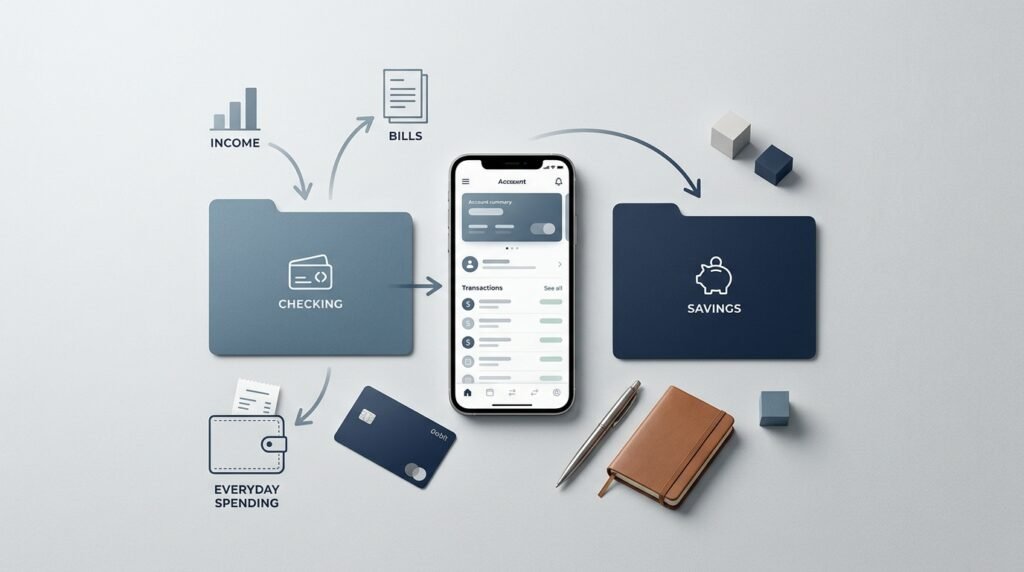
A simple banking system gives each account a clear job and creates a predictable path for money to move. For many beginners, that means using checking for income and everyday transactions, savings for money that should stay separate, and automatic transfers only where they make the system easier to manage.
What You'll Do
- ✓ Decide what job each bank account should perform.
- ✓ Map where income enters and where money leaves.
- ✓ Separate everyday transaction money from cash you want to keep aside.
- ✓ Add automation and extra accounts only when they solve a clear banking problem.
WHY THIS MATTERS
Why a Clear Banking System Makes Everyday Money Easier to Manage
Even when you have enough money overall, managing it can become confusing if income, bills, everyday transactions, and savings all compete inside the same account without a clear structure.
Your bank accounts are more than places to store money. They are the system through which income arrives, bills are paid, purchases are made, transfers happen, and cash is set aside.
When each account has no clear purpose, it becomes harder to tell which money is available for everyday use and which money needs to remain available for upcoming payments or other priorities.
A simple banking system creates clearer roles for your accounts and more predictable paths for money to move through them. The objective is not to create more accounts, but to make the accounts you use easier to understand and maintain.
PARENT GUIDE Banking →KEY IDEA
A simple banking system should make it clear where money enters, what each account is for, and how money moves between accounts.
STEP-BY-STEP METHOD
Map Your Banking System Before You Change It
Before opening new accounts or automating transfers, understand how your current banking setup works. These steps help you identify where money enters, where it leaves, and what job each account should perform.
STEP 1
List Every Bank Account You Currently Use
Start by writing down each checking and savings account that is part of your everyday money system.
Include accounts you use only occasionally. The goal is to see the entire structure before deciding whether anything needs to change.
PRACTICAL TIP
Note the institution, account type, and what you currently use each account for. If you cannot describe an account's purpose clearly, mark it for review.
STEP 2
Map Where Money Enters
Identify every recurring source of money that enters your banking system and the account where it arrives.
- Paycheck direct deposits
- Government benefits
- Transfers from another account
- Cash or check deposits
- Irregular income deposits
SIMPLE RULE
You should be able to identify your main income-entry account without having to check several places.
STEP 3
Map Where Money Leaves
Next, review the transactions that regularly move money out of each account. Recent statements can help you catch recurring activity you may have forgotten.
STEP 4
Identify Which Money Should Stay Separate
Look for money that should not routinely mix with everyday transactions. Keeping some cash separate can make your operating balance easier to understand.
- Money not intended for everyday spending
- Cash being held for future use
- Funds you want separated from routine debit activity
KEEP THE BOUNDARY CLEAR
This step is about where money is stored inside your banking system. Deciding how much to save or which savings goal comes first is a separate savings decision.
STEP 5
Give Each Account One Clear Primary Job
Once you can see how money enters and leaves, assign a primary purpose to each account.
EXAMPLE
Primary checking: receives income and
handles routine transactions.
Savings: holds money intentionally kept
outside the everyday transaction flow.
STEP 6
Draw the Simplest Version of Your Money Flow
Finish by reducing your banking setup to a simple flow you can understand at a glance. You are not changing the system yet; you are documenting how it should work.
- Where does income enter?
- Which account handles routine transactions?
- Where is separated cash kept?
- Which transfers already connect those accounts?
REAL-LIFE EXAMPLE
What a Simple Banking System Can Look Like
A banking system becomes easier to understand when you can see exactly where income arrives, which account handles transactions, and where money is kept separate.
EXAMPLE SCENARIO
Maya Uses One Checking Account and One Savings Account
Maya receives her paycheck by direct deposit into her primary checking account. Routine payments and everyday transactions come from checking, while money she does not intend to use for daily spending is transferred to savings.
| Banking Activity | Account |
|---|---|
| Paycheck direct deposit | Primary checking |
| Rent and recurring bills | Primary checking |
| Debit card purchases | Primary checking |
| ATM withdrawals | Primary checking |
| Transfer to separated cash | Checking → Savings |
| Main operating account | Primary checking |
| Separate storage account | Savings |
WHAT THIS SHOWS
Each Account Has One Clear Primary Job
Maya's checking account acts as the operating center of the system. Income arrives there, recurring payments are made from it, and everyday transactions happen there.
Her savings account has a different role: it keeps money she wants separated from routine spending. Because the jobs are distinct, Maya can understand the purpose of each account without adding unnecessary complexity.
SIMPLE FLOW
THE TAKEAWAY
A useful banking system does not need many accounts. It needs clear account roles and predictable money movement.
This example is illustrative. Your account structure, transaction patterns, fees, transfer options, and banking needs may be different.
ADAPT THE SYSTEM
When a Two-Account Setup Is Enough — and When It Is Not
A simple checking-plus-savings setup works well for many people. Additional accounts can help when they solve a specific banking problem, but more accounts also mean more balances, transfers, fees, and rules to manage.
SIMPLE SETUP
If One Checking Account and One Savings Account Already Work
Keep the system simple. Use checking as the main operating account and savings for money you want separated from routine transactions. There is no need to add accounts just because more complex systems exist.
BILL SEPARATION
If Everyday Spending Makes Upcoming Bills Hard to Track
A second checking account dedicated to recurring bills may create useful separation between routine spending and money that needs to remain available for scheduled payments.
MULTIPLE SAVINGS POOLS
If You Need Clearer Separation Between Different Cash Pools
Separate savings accounts or subaccounts can make different pools of cash easier to identify. The banking decision is about organization; deciding how much to save for each goal belongs to your broader savings plan.
MULTIPLE INSTITUTIONS
If You Use More Than One Bank or Credit Union
Using multiple institutions can work, but it adds another layer of transfer timing, login security, balance monitoring, and account terms. Make sure each institution has a clear role in the system.
NOT SURE IF YOU NEED ANOTHER ACCOUNT?
Start with the smallest setup that works. Add another account only when you can name the specific problem it will solve and the added fees, minimums, transfer rules, and maintenance still make sense.
FREE VERESTLY TOOL
Map Your Accounts With the Simple Banking System Planner
The Simple Banking System Planner helps you organize where income enters, what each account is responsible for, where money should stay separate, and how transfers connect the different parts of your banking setup.
- ✓ Give each checking or savings account a clear primary job.
- ✓ Map where income enters and where recurring money movement happens.
- ✓ Identify unnecessary complexity before adding another account.
Free · Beginner-friendly · Built for simple account organization
PRIMARY ACCOUNT
Checking
Example preview
REVIEWING YOUR CURRENT SETUP?
Start with the Banking hub to review account types, banking mechanics, fees, access, and other factors that can affect how your system works.
TAKE ACTION
Your Simple Banking System Action Plan
You do not need to redesign every account at once. Start by understanding your current setup, assign clear roles, then make changes only where they improve how your money moves.
TODAY
15–20 minutes
Inventory Your Current Accounts
Write down every checking and savings account you currently use and note what each one is doing today.
- List every active checking and savings account.
- Note where income is currently deposited.
- Identify which accounts handle bills and daily transactions.
- Mark any account whose purpose is unclear.
THIS WEEK
Build the structure
Give Each Account a Clear Job
Decide which account receives income, which handles routine transactions, and where money that should stay separate will be kept.
- Choose the main operating account.
- Define the role of each savings account.
- Remove overlap between accounts where possible.
- Identify transfers that connect the system.
NEXT BANKING CYCLE
Test and adjust
Watch How the System Works in Practice
Observe one complete cycle of deposits, payments, purchases, and transfers before adding more complexity or automation.
- Confirm deposits arrive where expected.
- Watch how recurring payments affect the operating balance.
- Check whether transfers happen at the right time.
- Adjust account roles if the system still feels confusing.
QUICK CHECK
A Good Banking System Should Answer Three Simple Questions
Can you clearly identify where income enters, what each account is for, and how money moves between those accounts?
COMMON MISTAKES
Mistakes That Make a Banking System Harder to Manage
A banking setup usually becomes difficult for a few predictable reasons: unclear account roles, too much complexity, poorly timed transfers, and not understanding how balances and fees work.
MISTAKE
Letting Every Account Do Everything
When several accounts receive income, pay bills, hold savings, and handle everyday spending at the same time, the system becomes harder to understand.
BETTER APPROACH
Give each account one clear primary job, even if it still handles a few secondary transactions.
MISTAKE
Opening More Accounts Without a Specific Reason
Additional accounts can improve separation, but they also add balances, fees, minimums, login security, and transfers that need to be monitored.
BETTER APPROACH
Add another account only when you can clearly explain the banking problem it will solve.
MISTAKE
Automating Transfers Before Understanding the Timing
An automatic transfer can create problems if it moves money before a deposit is available or leaves too little behind for another scheduled transaction.
BETTER APPROACH
Test the money flow first, then automate only stable transfers whose timing and account requirements you understand.
MISTAKE
Treating the Displayed Balance as Spendable Cash
Pending transactions, holds, scheduled payments, and deposits that are not yet available can make an account balance look more usable than it really is.
BETTER APPROACH
Pay attention to your institution's available balance and keep upcoming transactions in mind before spending.
MISTAKE
Ignoring Fees, Minimums, and Overdraft Settings
A system that looks organized can still become expensive if several accounts introduce maintenance fees, minimum-balance requirements, transfer charges, or overdraft costs.
BETTER APPROACH
Review the terms of each account and make sure the benefits of the setup justify any additional cost or maintenance.
REMEMBER
The best banking system is not the one with the most accounts. It is the one you can understand, monitor, and maintain without unnecessary fees or confusion.
FREQUENTLY ASKED QUESTIONS
Common Questions About Building a Simple Banking System
These questions cover the account-organization decisions that most often come up when you simplify how money moves through checking and savings.
How many bank accounts should I have? +
There is no universal number. Many beginners can build a workable banking system with one checking account and one savings account.
Additional accounts can be useful when they solve a clear problem, such as separating recurring bills from everyday transactions. Before adding one, consider fees, minimum requirements, transfer rules, and the extra maintenance involved.
Should I use a separate checking account just for bills? +
You can, but it is not required. A separate bills account may help if everyday purchases make it difficult to see how much money needs to remain available for scheduled payments.
If your existing checking account already makes upcoming obligations easy to track, adding another account may create more complexity than benefit.
Should my paycheck go into checking or savings? +
Checking is commonly used as the main destination for direct deposits because it is designed for routine transactions and payments.
Your institution may allow other arrangements. What matters for your banking system is knowing exactly where income enters and how money will move from there.
Should I automate transfers between my accounts? +
Automation can make a stable banking system easier to maintain, but it should come after you understand the timing of deposits, payments, and transfers.
Check when funds are expected to be available, which account sends the money, and what happens if the balance is insufficient. Transfer timing and account policies can vary by institution.
Do I need accounts at more than one bank or credit union? +
No. A simple banking system can operate entirely within one institution if its accounts, fees, access, and features meet your needs.
Using multiple institutions can make sense in some situations, but it also creates additional transfer timing, security, balance-monitoring, and account-management tasks.
What is the difference between my current balance and available balance? +
Your current balance reflects transactions the institution has posted to the account. Your available balance generally reflects the amount the institution currently considers available for use after accounting for certain holds, pending activity, or unavailable deposits.
Exact calculations and timing can vary by institution, so review your bank or credit union's account terms and funds-availability policies.
KEEP LEARNING
Continue With the Accounts That Power Your System
These guides explain the core account types and how they work together inside a simple banking setup.
Checking Accounts Explained: What Beginners Need to Know
Learn how checking accounts handle deposits, payments, debit transactions, cash access, and everyday banking activity.
Checking account guide →Savings Accounts Explained: How They Work and What to Look For
Understand how savings accounts store cash separately, earn interest, and fit into everyday banking.
Savings account guide →Checking vs. Savings Accounts: What Is the Difference?
See how checking and savings serve different jobs and how the two accounts can work together.
Compare checking and savings →EXPLORE THE FULL BANKING SYSTEM
Return to the Banking hub for beginner guides on checking, savings, fees, account access, transfers, and organizing your everyday banking.
SOURCES & METHODOLOGY
How We Verified This Guide
Verestly prioritizes primary government sources and financial regulators when verifying banking mechanics, consumer protections, deposit insurance, automatic payments, overdrafts, and account management guidance.
LAST REVIEWED
September 2026
This guide was reviewed for banking accuracy, source quality, account terminology, consumer-protection guidance, and consistency with current federal banking resources.

ABOUT THE AUTHOR
Edvaldo Ribeiro
Edvaldo Ribeiro creates beginner-focused personal-finance education for Verestly, with an emphasis on practical systems, clear explanations, and actionable financial tools.
View author profile →VERESTLY NEWSLETTER
Get Practical Money Guides and Tools
Join Verestly for beginner-friendly financial education, new tools, practical systems, and resources you can actually use.
Free resources · Beginner-friendly · Unsubscribe anytime
RELATED GUIDES
Continue Building Your Banking System
Explore the account guides that explain how checking and savings work individually and how they can work together.