BANKING · FOCUSED ANSWER
Savings Accounts Explained: How They Work and What to Look For
A savings account gives you a place to hold money separately from everyday spending while potentially earning interest. Learn how these accounts work and what to compare before choosing one.

IN PLAIN ENGLISH
The Short Answer
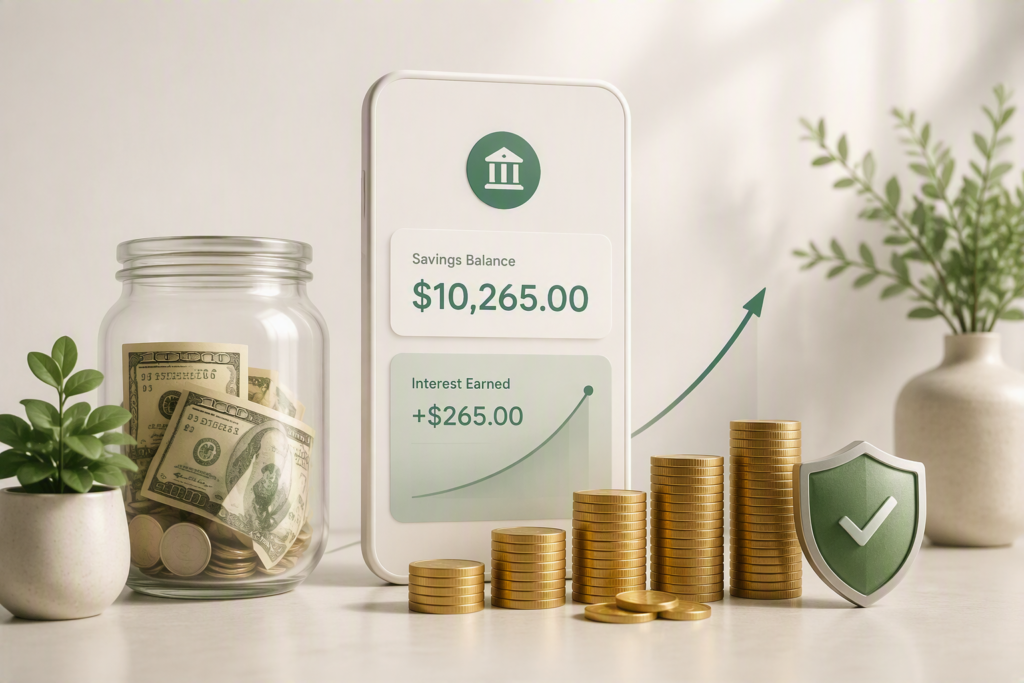
A savings account is a deposit account designed primarily for money you want to keep rather than spend every day. Depending on the account, your balance may earn interest while remaining accessible through transfers, withdrawals, or other methods offered by the institution.
Savings accounts can differ in their APYs, fees, minimum balance requirements, access options, and other terms. That means the account with the highest advertised rate is not automatically the best fit for how you plan to use it.
SIMPLE FLOW
Deposit money → keep a balance → potentially earn interest
HOW IT WORKS
How Savings Account Interest Works
Many savings accounts pay interest on the money you keep deposited. When comparing accounts, the two numbers you will commonly see are the interest rate and the annual percentage yield, or APY.
INTEREST RATE
The Interest Rate Helps Determine What You Earn
The interest rate is the rate the financial institution uses when calculating interest on eligible money held in your savings account.
APY
APY Makes Account Comparisons Easier
Annual percentage yield reflects how much an account can earn over a year when compounding is taken into account, assuming the applicable account conditions are met.
IMPORTANT DETAIL
Your Savings Account APY May Change
Many savings accounts have variable rates. That means the interest rate and APY available when you open the account may increase or decrease later according to the institution's account terms.
Some accounts may also use balance tiers, promotional rates, or other conditions. Check which balance qualifies for the advertised APY instead of relying on the headline rate alone.
KEY PRINCIPLE
Use APY when comparing interest-bearing savings accounts, but also check whether the rate is variable and whether balance tiers or other conditions apply.
SIMPLE EXAMPLE
Why Access and Fees Matter Alongside APY
Two savings accounts can look similar at first glance but work differently once you compare how you can access your money and what conditions apply.
SAVINGS ACCOUNT 1
Account A
SAVINGS ACCOUNT 2
Account B
ACCOUNT COMPARISON
Look Beyond the Headline Rate
Account A may advertise the stronger APY, but its monthly fee and waiver requirements could affect what you actually keep. Account B may pay a lower APY while offering simpler access and no monthly maintenance fee.
WHAT THIS SHOWS
A higher APY does not automatically make one savings account more useful than another. Fees, minimum-balance requirements, transfer options, and how easily you can access your money can materially change the comparison.
This is a simplified illustration, not a comparison of actual accounts. Savings-account rates, fees, access methods, and eligibility requirements vary by financial institution.
WHAT THIS MEANS FOR YOU
What to Check Before Choosing a Savings Account
A savings account should work well for the way you plan to hold and access your money. Compare more than the advertised APY by checking the account's fees, minimums, access options, and terms.
COMPARE THE RATE
Look at APY, Not Just the Advertised Interest Rate
APY accounts for compounding and gives you a more useful standardized number for comparing interest-bearing accounts. Also check whether the APY is variable, promotional, or tied to a particular balance tier.
REVIEW THE FEES
Check What It Costs to Keep the Account
Look for monthly maintenance fees, minimum-balance requirements, ATM charges, and other account-specific fees. If a fee can be waived, confirm exactly what conditions you need to meet.
CHECK YOUR ACCESS
Make Sure You Can Move the Money When You Need It
Compare bank-to-bank transfers, internal transfers, ATM access, branch access, and typical transfer timing. An account can offer an attractive APY but still be inconvenient if its access options do not fit how you expect to use it.
VERIFY THE TERMS
Confirm Minimums, Limits, and Deposit Insurance
Review the minimum opening deposit, balance requirements, transaction rules, and other account conditions. Also confirm whether the institution is federally insured and which deposit-insurance system applies.
SIMPLE FRAMEWORK
Use the Verestly R-A-F-T Check
Compare Rate, Access, Fees, and Terms before choosing a savings account. This is a Verestly educational framework, not an official banking standard.
PRACTICAL RULE
Do not choose a savings account from APY alone. Compare the rate with the account's access, fees, and terms to understand how it will actually work for you.
COMMON MISUNDERSTANDINGS
What People Often Get Wrong About Savings Accounts
Savings accounts are straightforward, but a few outdated rules and common assumptions can make them harder to compare correctly.
MISUNDERSTANDING
“Savings Accounts Are Federally Limited to Six Withdrawals a Month”
The former federal Regulation D limit on certain savings-account withdrawals and transfers was removed in 2020. It should no longer be treated as a universal federal six-transaction rule.
BETTER WAY TO THINK ABOUT IT
Your bank or credit union may still impose its own transaction limits, fees, or account rules, so check the institution's terms.
MISUNDERSTANDING
“The Highest APY Automatically Means the Best Account”
A strong APY can help your balance earn more interest, but it does not tell you whether the account has fees, minimums, limited access options, or other conditions.
BETTER WAY TO THINK ABOUT IT
Compare the rate together with access, fees, and account terms before deciding whether the account fits your needs.
MISUNDERSTANDING
“The APY I Open With Is Guaranteed to Stay the Same”
Many savings accounts use variable rates. The interest rate and APY can rise or fall after the account is opened according to the institution's terms.
BETTER WAY TO THINK ABOUT IT
Treat an advertised APY as a current account term unless the institution specifically guarantees it for a defined period.
MISUNDERSTANDING
“Every Savings Account Is Automatically FDIC Insured”
FDIC insurance applies to eligible deposits held at FDIC-insured banks. Federally insured credit unions use NCUA-administered share insurance instead.
BETTER WAY TO THINK ABOUT IT
Confirm that the institution is federally insured and understand how the ownership of your accounts affects coverage.
REMEMBER
Savings-account terms are not universal. Rates, fees, access rules, minimums, and transaction limits can vary by institution, so review the account disclosure before opening an account.
FREQUENTLY ASKED QUESTIONS
Common Questions About Savings Accounts
These are some of the most common questions beginners have when comparing how savings accounts work.
Can a savings account lose money? +
The balance in a savings account does not normally fluctuate with financial markets the way an investment can. However, account fees can reduce your balance, and inflation can reduce the purchasing power of the money over time.
Is a higher APY always better? +
A higher APY can help your money earn more interest, but it should not be compared in isolation. Fees, minimum-balance requirements, access options, rate conditions, and other account terms can affect how useful the account is for you.
Can the APY on a savings account change? +
Yes. Many savings accounts have variable interest rates, which means the rate and APY can increase or decrease after you open the account according to the institution's terms.
Are all savings accounts FDIC insured? +
No. Eligible deposits at FDIC-insured banks can receive FDIC protection, subject to applicable coverage rules. Federally insured credit unions use NCUA-administered share insurance instead. Always confirm the institution's insurance status rather than assuming every account has the same protection.
Are savings accounts still limited to six withdrawals per month? +
The former federal Regulation D limit on certain savings-account withdrawals and transfers was removed in 2020. However, banks and credit unions may still set their own transaction limits, fees, or other account conditions.
WHAT TO DO NEXT
Compare the Account Before You Open It
Once you understand how savings accounts work, the next step is to compare the terms that affect your actual experience with the account.
Compare Rate, Access, Fees, and Terms
Use the Verestly R-A-F-T framework to review the APY, access options, account fees, minimums, and other terms before choosing a savings account.
Confirm the Institution's Deposit Insurance
Determine whether the account is held at an FDIC-insured bank or a federally insured credit union, and understand how applicable ownership rules affect coverage.
BEFORE YOU OPEN AN ACCOUNT
Read the institution's account disclosure and fee schedule. Savings-account rates, minimums, transfer rules, and fees can differ substantially between institutions.
SOURCES & METHODOLOGY
How We Verified This Answer
Verestly prioritizes primary government and regulatory sources when verifying savings-account disclosures, withdrawal rules, fees, and federal deposit-insurance protections.
LAST REVIEWED
September 2026
This answer was reviewed for banking-rule accuracy, deposit-insurance guidance, source quality, and clarity for beginners.

ABOUT THE AUTHOR
Edvaldo Ribeiro
Edvaldo Ribeiro creates beginner-focused personal-finance education for Verestly, with an emphasis on clear explanations, practical systems, and useful financial tools.
View author profile →VERESTLY NEWSLETTER
Get Clearer Answers to Everyday Money Questions
Get beginner-friendly financial education, practical tools, and simple explanations designed to help you make more informed money decisions.
Free resources · Beginner-friendly · Unsubscribe anytime
RELATED ANSWERS
Keep Exploring Banking Basics
Continue with closely related guides to better understand everyday bank accounts, cash access, and deposit protection.