
SAVING · FOCUSED ANSWER
How to Separate Bills, Spending, and Savings Accounts
Separating money by purpose can make it easier to see what is reserved for bills, what is available for everyday spending, and what you want to protect for future needs and savings goals.

IN PLAIN ENGLISH
The Short Answer
A simple way to separate your money is to give bills, everyday spending, and savings different jobs. Money for expected obligations stays reserved, spending money remains available for day-to-day purchases, and savings is kept apart for future needs and goals.
You do not necessarily need three separate bank accounts. The important part is creating enough separation that you can quickly tell what money is already committed, what you can spend, and what you intend to leave untouched.
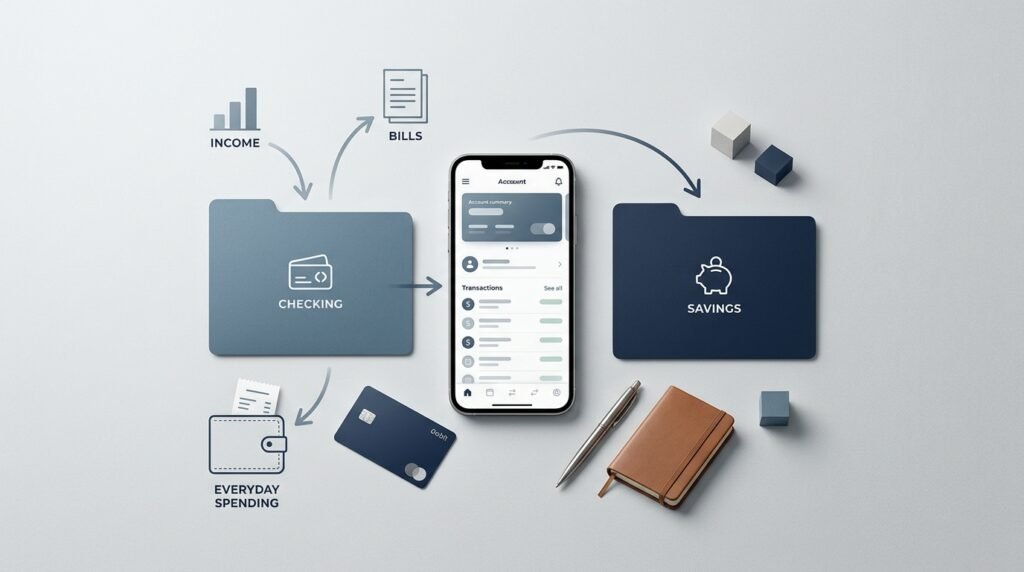
SIMPLE MONEY FLOW
Income can be assigned to three different jobs before you spend it.
HOW IT WORKS
How a Bills, Spending, and Savings Setup Works
The idea is simple: separate money based on what it needs to do. One part covers expected obligations, another stays available for everyday spending, and another is protected for future needs and savings goals.
BILLS MONEY
Reserve Expected Obligations First
Money for rent, utilities, insurance, subscriptions, minimum debt payments, and other expected obligations can be kept separate from money available for flexible spending.
SPENDING & SAVINGS
Separate What You Can Spend From What You Want to Keep
Everyday spending money remains available for flexible purchases, while savings is moved or designated for emergencies, planned expenses, and other short-term goals.
IMPORTANT DETAIL
Three Money Jobs Do Not Always Require Three Accounts
You might use separate accounts for bills, spending, and savings, but that is only one possible setup. Some people may prefer two accounts, while others may use account features that let them organize savings into separate goals or buckets.
The goal is not to create more accounts than you need. It is to make the purpose of your money clear enough that savings is less likely to be confused with money available to spend.
KEY PRINCIPLE
Separate money by purpose first. The number of accounts is secondary to having a system that makes committed money, spendable money, and savings easy to distinguish.
SIMPLE EXAMPLE
What Separating Bills, Spending, and Savings Can Look Like
A simple example can show how separating money by purpose helps you see what is already committed, what is available to spend, and what you are intentionally setting aside.
MONEY JOB 1
Bills
MONEY JOB 2
Spending
MONEY JOB 3
Keep Savings Separate From Spendable Money
In this example, the person brings home $3,200 for the month. After reserving $2,100 for bills and $700 for everyday spending, $400 is intentionally set aside for savings.
WHAT THIS SHOWS
Once the $2,100 reserved for bills and the $400 assigned to savings are separated, the full checking balance no longer looks like money that is available to spend. The system makes each part of the monthly income easier to identify by purpose.
This is a simplified example, not a recommended allocation. Your amounts may look very different depending on your income, essential expenses, savings goals, household needs, and other financial priorities.
WHAT THIS MEANS FOR YOU
How to Use Separate Money Buckets in Real Life
The goal is not to create a complicated system. It is to make sure money for bills, everyday spending, and savings has a clear purpose before you start using it.
RESERVE BILLS FIRST
Keep Expected Obligations Out of Your Spendable Balance
Once you know which expenses are already committed, keep that money clearly separated so it is less likely to be mistaken for money available for everyday purchases.
DEFINE SPENDING MONEY
Know What Is Actually Available to Spend
A separate spending amount can make your available money easier to read because bills and savings are no longer mixed into the same balance you use for flexible purchases.
Build a simple banking system →PROTECT SAVINGS
Keep Savings From Looking Like Extra Spending Money
Money for emergencies, planned expenses, and short-term goals is easier to protect when it is clearly separated from the money you regularly use for bills and everyday spending.
Learn where to keep your emergency fund →KEEP IT SIMPLE
Use Only as Much Separation as You Can Maintain
More accounts do not automatically create a better system. If two accounts, savings buckets, or another simple setup give your money clear jobs, that may be enough.
FREE VERESTLY TOOL
Map the Purpose of Each Account
Use the Account Purpose Planner to decide what each account is for, what money should move through it, and whether your current setup is clearer or more complicated than it needs to be.
PRACTICAL RULE
Your account setup should make it easier to tell the difference between committed money, spendable money, and savings without creating more complexity than you can comfortably manage.
COMMON MISUNDERSTANDINGS
What People Often Get Wrong About Separating Their Money
Separating bills, everyday spending, and savings can make your money easier to manage, but the system works best when it stays simple, intentional, and matched to your actual needs.
MISUNDERSTANDING
“I Need Three Separate Bank Accounts”
Bills, spending, and savings are three different jobs for your money, but that does not mean everyone needs exactly three separate accounts.
BETTER WAY TO THINK ABOUT IT
Use the simplest combination of accounts or savings buckets that keeps committed money, spendable money, and savings easy to distinguish.
MISUNDERSTANDING
“Anything Left After Monthly Bills Is Spending Money”
Some money may already have a future job even if the expense is not due this month. Annual bills, planned maintenance, and other predictable costs can still require money to be set aside in advance.
BETTER WAY TO THINK ABOUT IT
Treat known future expenses as planned savings when appropriate instead of assuming every remaining dollar is available for everyday spending.
MISUNDERSTANDING
“All Savings Should Be Treated Like an Emergency Fund”
Savings can serve different purposes. Emergency reserves, sinking funds for predictable expenses, and short-term goals may all involve money being set aside, but they are not the same type of savings.
BETTER WAY TO THINK ABOUT IT
Separate savings by purpose when doing so makes it easier to distinguish unexpected emergencies from planned costs and other financial goals.
MISUNDERSTANDING
“More Accounts Automatically Mean Better Organization”
Every additional account can create another balance, transfer, and moving part to monitor. A system can become harder to maintain even when it looks more organized on paper.
BETTER WAY TO THINK ABOUT IT
Add another account only when it solves a clear problem, such as protecting savings or keeping bill money separate from everyday spending.
REMEMBER
The goal is clarity, not account quantity. A useful system makes it easier to protect bills, understand what you can spend, and keep savings assigned to its intended purpose.
FREQUENTLY ASKED QUESTIONS
Common Questions About Separating Bills, Spending, and Savings
These are some of the most common questions beginners have when deciding how much separation they need between everyday money, expected obligations, and savings.
Do I need separate bank accounts for bills, spending, and savings? +
No. Bills, spending, and savings are different jobs for your money, but they do not always require three separate accounts. You might use three accounts, two accounts plus savings buckets, or another simple arrangement that makes each purpose easy to identify.
Should bills and everyday spending be kept separate? +
Separating them can help if you often have trouble telling how much of your checking balance is actually available to spend. The useful part is making money already committed to expected bills clearly different from flexible spending money.
Should emergency savings and sinking funds be kept together? +
They can be held in the same account if you can clearly track what each portion is for. The important distinction is that emergency savings is intended for unexpected expenses, while sinking funds are generally used for predictable future costs.
Can I automate transfers between my accounts? +
Yes. Automatic transfers can help move money toward bills or savings after income arrives. Before automating them, make sure the timing and amounts fit your actual cash flow so your spending or bill-paying account still has enough money for upcoming transactions.
How do I know if my account system is too complicated? +
If you are frequently moving money between accounts, forgetting what each account is for, or spending more time maintaining the system than using it, simplifying may help. Each account should have a clear purpose that solves a specific organizational problem.
WHAT TO READ NEXT
Build a Clearer System Around Your Accounts
Once bills, spending, and savings have clear jobs, the next step is deciding how those accounts should work together and how your savings should be organized by purpose.
How to Build a Simple Banking System for Your Money
See how checking, spending, bills, savings, and transfers can work together in a simple system you can maintain.
Where Should You Keep Your Emergency Fund?
Learn what to consider when deciding where emergency savings should live and how accessible it should be.
WANT TO ORGANIZE YOUR ACCOUNTS?
Use the Account Purpose Planner to define what each account is for, what money belongs there, and whether your current setup is simpler or more complex than needed.
SOURCES & METHODOLOGY
How We Verified This Answer
Verestly prioritizes primary government sources, regulators, and authoritative consumer-finance guidance when reviewing information about bank accounts, savings systems, cash flow, and emergency savings.
LAST REVIEWED
October 2026
This answer is periodically reviewed for clarity, accuracy, source quality, and relevant changes to consumer-finance guidance.

ABOUT THE AUTHOR
Edvaldo Ribeiro
Edvaldo Ribeiro creates beginner-focused personal-finance education for Verestly, with an emphasis on clear explanations, practical systems, and useful financial tools.
View author profile →THE VERESTLY NEWSLETTER
Build a Better Money System, One Step at a Time
Get practical guides, financial tools, and beginner-friendly
resources designed to help you make clearer money decisions.
✓ Practical financial education
✓ New calculators and tools
✓ Actionable money systems
No spam. Just practical money guidance. Unsubscribe anytime.

RELATED ANSWERS
Keep Exploring
Continue with three closely related guides selected to deepen your understanding.