SAVING · FOCUSED ANSWER
How Credit Card Interest Works
Credit card interest is the cost of borrowing money on your card. Learn how APR becomes an interest charge, why your balance and timing matter, and when a grace period may help you avoid interest on purchases.
IN PLAIN ENGLISH
The Short Answer
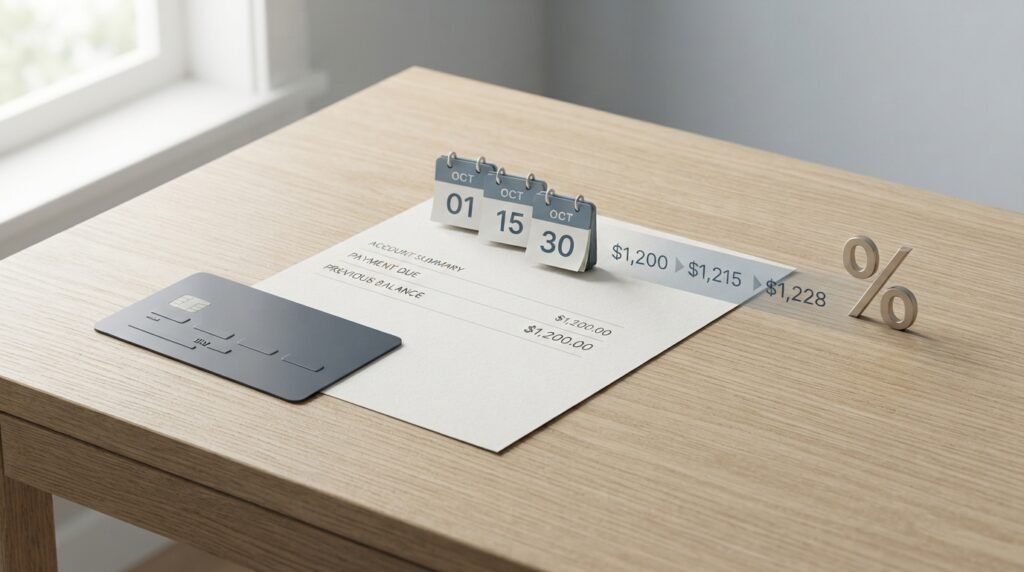
Credit card interest is the cost of borrowing money on your card. Your account shows an annual percentage rate, or APR, but many issuers calculate the interest you owe using your balance on a daily basis.
The amount you actually pay can depend on your APR, the balance subject to interest, how long that balance remains unpaid, the type of transaction, and whether your card provides a grace period for purchases.
SIMPLE IDEA
APR → daily rate → balance → interest charge
HOW IT WORKS
How Credit Card Interest Is Calculated
Credit card interest often starts with your APR, which an issuer may convert into a daily periodic rate and apply to the balance that is subject to interest.
DAILY RATE
Your APR Can Be Converted Into a Daily Rate
If an issuer uses 365 days, a 24% APR would translate to an approximate daily periodic rate of 0.0658%. Some issuers may use a different divisor, so your card agreement controls.
INTEREST CHARGE
The Daily Rate Is Applied to the Balance
Using a simplified example with a $1,000 balance that remains unchanged for 30 days, the daily rate can be used to estimate the interest for that period.
IMPORTANT DETAIL
Your Balance Can Change Throughout the Billing Cycle
The $19.73 example assumes that the balance stays at $1,000 for the entire 30-day period. In real life, purchases, payments, credits, fees, and interest can change the balance from one day to the next.
Because many issuers use daily balances or an average daily balance, those changes can affect the amount of interest ultimately charged on your statement.
KEY PRINCIPLE
The interest you pay depends on more than the APR alone. The balance subject to interest, how that balance changes, the number of days involved, and your issuer's calculation method can all affect the final charge.
SIMPLE EXAMPLE
How a Grace Period Can Help You Avoid Purchase Interest
Many credit cards offer a grace period on purchases. When the card's requirements are met, paying the applicable balance in full by the due date may allow you to avoid interest on those purchases.
SCENARIO 1
Balance Paid in Full
SCENARIO 2
Balance Not Paid in Full
WHY THE DIFFERENCE MATTERS
A Grace Period Can Change Whether Purchase Interest Is Charged
In the first scenario, the cardholder pays the full statement balance by the due date and, assuming the card offers a qualifying purchase grace period and its conditions are met, purchase interest may be avoided.
WHAT THIS SHOWS
Having an APR does not automatically mean every purchase will generate interest. Whether purchase interest is charged can depend on whether your card provides a grace period and whether you satisfy the conditions required to keep it.
Grace periods are not guaranteed on every card and may not apply to transactions such as cash advances. Always check your card agreement for the rules that apply to your account.
WHAT THIS MEANS FOR YOU
What Changes the Amount of Interest You Pay
Your APR matters, but it is only one part of the calculation. The balance subject to interest, how long that balance remains outstanding, and the type of transaction can all affect the final interest charge.
YOUR APR
A Higher Rate Can Increase Borrowing Costs
When the balance, number of days, and calculation method are otherwise the same, a higher APR generally produces a larger interest charge.
YOUR BALANCE
The Amount Subject to Interest Matters
Interest is calculated on the applicable balance, not on your total credit limit. A larger balance subject to the same rate generally creates a larger interest charge.
TIME AND PAYMENTS
How Long the Balance Remains Outstanding Can Matter
Because many issuers calculate interest using daily balances, the number of days a balance remains unpaid and when payments are credited can influence the amount of interest charged.
TRANSACTION TYPE
Different Balances May Have Different APRs
Purchases, balance transfers, cash advances, and promotional balances may be subject to different rates and different interest rules under your card agreement.
PRACTICAL RULE
Do not judge the cost of a credit card by APR alone. Look at the rate, the balance subject to interest, how long the balance remains outstanding, and the terms that apply to that type of transaction.
COMMON MISUNDERSTANDINGS
What People Often Get Wrong About Credit Card Interest
Credit card interest is easier to understand once you separate the APR from the actual dollar amount charged and look at the terms that apply to your specific balance.
MISUNDERSTANDING
“APR Is the Exact Amount of Interest I Will Pay”
APR is a rate, not a fixed dollar charge. The amount of interest you actually pay depends on the balance subject to interest, the number of days involved, and the issuer's calculation method.
BETTER WAY TO THINK ABOUT IT
Use APR as the starting rate, then look at the balance and timing that determine the actual interest charge.
MISUNDERSTANDING
“Every Credit Card Uses APR ÷ 365”
Dividing APR by 365 is a common example, but it is not a universal rule. Some issuers may use a different divisor or calculation method under the card agreement.
BETTER WAY TO THINK ABOUT IT
Treat APR ÷ 365 as an illustration unless your card agreement confirms that method.
MISUNDERSTANDING
“Having an APR Means I Pay Interest on Every Purchase”
Many cards offer a grace period on purchases. When the required conditions are met, you may be able to avoid purchase interest even though the account still has an APR.
BETTER WAY TO THINK ABOUT IT
Check whether your card offers a purchase grace period and what you must do to keep it.
MISUNDERSTANDING
“I Need to Carry a Balance to Build Credit”
Carrying an interest-bearing balance is not required simply to build credit. You can use a credit card and manage the account responsibly without intentionally paying interest.
BETTER WAY TO THINK ABOUT IT
Responsible account use and paying interest are two different things.
REMEMBER
The exact way interest is calculated depends on your card agreement, balance type, and account terms. Use examples as guides, not as guaranteed predictions of your actual charge.
FREQUENTLY ASKED QUESTIONS
Common Questions About Credit Card Interest
These questions clarify when interest may be charged, how the calculation works, and why the amount can differ from one account or billing cycle to another.
Do credit cards charge interest every day? +
Many credit card issuers calculate interest using a daily periodic rate and daily balances. The resulting interest charge is generally reflected on your billing statement. The exact method depends on your card agreement.
Do I pay interest if I pay my credit card in full? +
If your card offers a grace period on purchases and you meet its requirements, paying the applicable balance in full by the due date may allow you to avoid purchase interest.
Different rules may apply to cash advances, balance transfers, promotional balances, or an account that has lost its purchase grace period.
Is credit card interest based on the statement balance or current balance? +
Interest is calculated according to the balance-computation method used by the issuer. That may involve daily balances or an average daily balance rather than simply using one balance number displayed in your account.
Understand statement balance, current balance, and minimum payment →Is APR the same as the amount of interest I pay? +
No. APR is a rate. The actual dollar amount of interest can depend on the balance subject to interest, how long that balance remains outstanding, the calculation method, and the terms that apply to the account.
Does carrying a balance help build credit? +
You do not need to carry an interest-bearing balance simply to build credit. Credit outcomes can depend on multiple factors and may vary by scoring model and lender.
See how credit scores work →WHAT TO READ NEXT
Understand the Rest of Your Credit Card
Interest makes more sense when you understand the broader mechanics of a credit card and the different balance and payment amounts shown on your statement.
How Credit Cards Work: A Beginner’s Guide
Learn how purchases, billing cycles, payments, credit limits, and borrowing costs fit together.
Statement Balance vs. Current Balance vs. Minimum Payment
Understand the different amounts shown on your account and what each one means when it is time to make a payment.
SOURCES & METHODOLOGY
How We Verified This Answer
Verestly prioritizes primary government sources, regulators, and authoritative consumer-finance references when verifying credit card interest, APR, grace periods, and balance-calculation methods.
LAST REVIEWED
September 2026
This answer is periodically reviewed for clarity, accuracy, source quality, and relevant changes to consumer credit card rules and guidance.

ABOUT THE AUTHOR
Edvaldo Ribeiro
Edvaldo Ribeiro creates beginner-focused personal-finance education for Verestly, with an emphasis on clear explanations, practical systems, and useful financial tools.
View author profile →VERESTLY NEWSLETTER
Get Clearer Answers to Everyday Money Questions
Get beginner-friendly financial education, practical tools, and simple explanations designed to help you make more informed money decisions.
Free resources · Beginner-friendly · Unsubscribe anytime
RELATED ANSWERS
Keep Exploring
Continue with three closely related guides selected to deepen your understanding of credit card mechanics.