
CREDIT & CREDIT CARDS · FOCUSED ANSWER
How Credit Card Interest Works
You open your credit card statement and notice an interest charge you weren't expecting. You made a payment, maybe even more than the minimum, so why are you still being charged?
The answer usually comes down to three things: your balance, your interest rate, and when your payments were made.
Here's how credit card interest works, how to estimate what it might cost, and what to check when a charge doesn't make sense.
IN PLAIN ENGLISH
How Does Credit Card Interest Work?
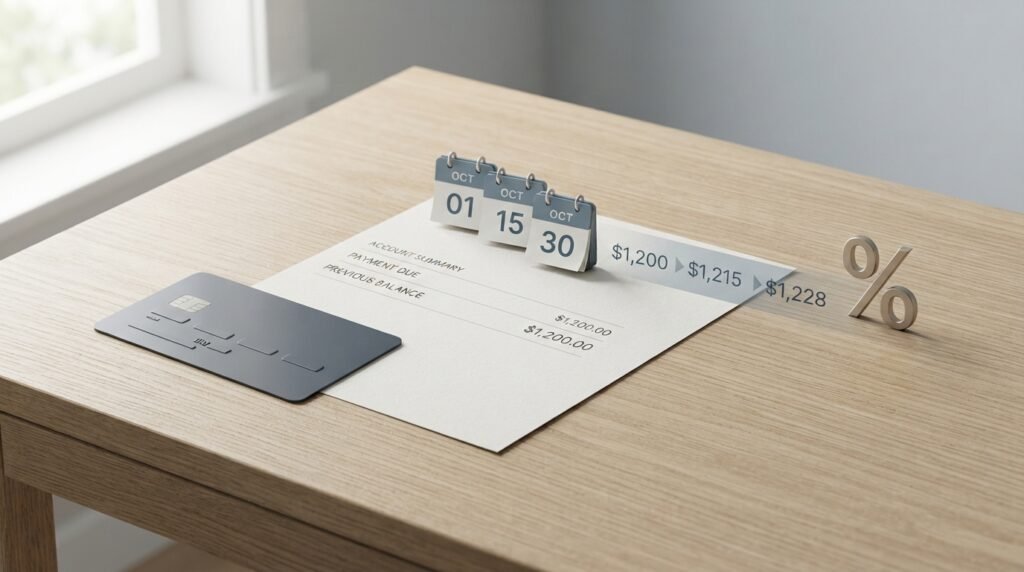
Credit card interest is the cost of borrowing money through your card. When you have a balance subject to interest, your card issuer generally calculates the charge using your annual percentage rate (APR), the amount you owe, and how long that balance remains outstanding.
But using a credit card doesn't automatically mean paying interest.
Most credit cards offer a grace period on purchases. If your card has one, and you meet its conditions by paying the required statement balance in full by the due date, you can generally avoid interest on those purchases.
Not every credit card offers a grace period, and different transactions may follow different rules.
That's why understanding your card's terms matters more than simply knowing its APR.
SIMPLE IDEA
APR → daily rate → balance → interest charge
HOW IT WORKS
How Credit Card Interest Is Calculated
You don't need to understand every detail of your card agreement to make sense of an interest charge. Four concepts explain most of the calculation: your APR, daily interest rate, balance, and grace period.
PURCHASE APR
Your APR Is an Annual Rate
Your annual percentage rate (APR) helps determine how much interest your issuer charges on balances subject to interest.
A 24% purchase APR doesn't mean you'll automatically pay 24% of your balance every month.
For a deeper explanation, see our guide to credit card APR.
DAILY RATE
Your APR Can Become a Daily Rate
Many credit card issuers calculate interest using a daily periodic rate.
One common method divides the APR by 365. At a 24% APR, that works out to approximately 0.06575% per day.
This is a common calculation convention, not a universal requirement. Your card agreement may use a different method.
IMPORTANT DETAIL
Your Balance Changes Throughout the Billing Cycle
Your balance can change when purchases, payments, and credits are posted to your account.
Many issuers use an average daily balance to calculate interest. In simplified terms, they add the balances for each day of the billing cycle and divide the total by the number of days.
Depending on the agreement, interest already added to the balance may also affect future calculations. This can result in compounding.
THE ROLE OF YOUR GRACE PERIOD
A purchase grace period can allow you to avoid interest on eligible purchases when you meet your card's conditions, generally by paying the required statement balance in full by the due date.
If you carry an unpaid balance, you may lose that benefit. Your card agreement explains whether a grace period is available and how it works.
SIMPLE EXAMPLE
Credit Card Interest Calculation: A Simple Example
Suppose you have a $1,000 credit card balance that's already subject to interest, with a purchase APR of 24%. How much interest could that balance generate over 30 days?
Let's calculate it using a simplified example with a constant balance, no additional transactions, payments, fees, or compounding.
STEP 01
Calculate the Daily Rate
STEP 02
Estimate the Daily Interest
STEP 03 — THE 30-DAY ESTIMATE
How Much Interest Builds Over 30 Days?
Under our assumptions, the $1,000 balance remains subject to interest for the entire 30-day period.
To estimate the total, multiply the balance by the unrounded daily periodic rate and then by 30 days.
This gives us approximately $19.73 in interest for the period.
WHAT THIS SHOWS
Under these assumptions, a $1,000 interest-bearing balance at 24% APR would generate approximately $19.73 in interest over 30 days.
Interest depends on both the amount subject to interest and how long that amount remains outstanding. Changes in either can affect the final charge.
Important: This is a simplified educational estimate, not a prediction of your credit card statement. It assumes a constant interest-bearing balance, a 30-day period, APR divided by 365, and no compounding, additional transactions, payments, or fees. Actual interest charges may differ because of daily balance changes, posting dates, compounding, transaction-specific APRs, and your issuer's calculation method. Check your card agreement for the rules that apply to your account.
WHAT THIS MEANS FOR YOU
When Do You Actually Pay Credit Card Interest?
Understanding the calculation is useful, but knowing when interest applies is what helps you make sense of your statement. Your payment amount, timing, grace-period conditions, and transaction types can all affect whether interest is charged.
PAYING IN FULL
Paying Your Statement Balance Can Help You Avoid Purchase Interest
If your credit card offers a purchase grace period and you meet its conditions, paying the required statement balance in full by the due date generally allows you to avoid interest on eligible purchases.
This doesn't necessarily eliminate interest associated with cash advances, certain balance transfers, or amounts that were already accruing interest.
If you've previously lost your grace period, interest that accrued before your payment was processed may still appear on a later statement.
MINIMUM PAYMENT
Paying the Minimum Doesn't Necessarily Stop Interest
Making at least the required minimum payment by the due date generally prevents that payment from being late. But it doesn't necessarily stop interest.
Imagine receiving a statement with a $1,000 balance and making a $40 payment. Assuming no other adjustments, $960 of that statement balance would remain unpaid.
That doesn't mean your issuer calculates interest on exactly $960 for the entire billing cycle. The actual charge depends on the applicable daily balances, transaction dates, and calculation method.
GRACE PERIOD
Carrying a Balance May Affect Your Grace Period
If you don't meet the conditions for your purchase grace period, new purchases may begin accruing interest sooner than you expect.
Even after you make a later payment in full, your purchase grace period may not be restored immediately.
Check your card agreement to understand how the benefit can be regained. The requirements can vary by issuer.
TRANSACTION TYPE
Different Transactions May Follow Different Interest Rules
Not every balance on your card is treated the same way.
Cash advances commonly begin accruing interest immediately and may have a different APR. Balance transfers can have separate rates, fees, or promotional conditions.
When your account contains balances with different APRs, payment-allocation rules can also affect which balances are reduced first.
PRACTICAL TAKEAWAY
Paying the required statement balance in full by the due date can help you avoid interest on eligible purchases when your grace-period conditions are met. Paying only the minimum may leave an interest-bearing balance, while other transaction types can follow different rules.
If you're unsure which amount matters on your statement, our guide to statement balance vs. current balance vs. minimum payment explains the differences.
COMMON MISUNDERSTANDINGS
Common Credit Card Interest Misunderstandings
A few common assumptions about credit card interest can lead to unexpected charges. Here's what actually matters when you're reviewing your balance, payments, and card terms.
MISUNDERSTANDING
“If I Pay the Minimum, I Won't Pay Interest”
Paying at least the required minimum by the due date generally prevents that payment from being late. However, any remaining balance subject to interest can continue generating charges.
BETTER WAY TO THINK ABOUT IT
The minimum payment and the amount needed to avoid purchase interest are not necessarily the same.
MISUNDERSTANDING
“Every Credit Card Purchase Generates Interest”
Using a credit card doesn't automatically mean paying interest. Many cards offer a purchase grace period that allows qualifying purchases to avoid interest when the applicable conditions are met.
BETTER WAY TO THINK ABOUT IT
Check whether your card offers a purchase grace period and what you must do to keep it.
MISUNDERSTANDING
“My APR Tells Me Exactly How Much Interest I'll Pay This Month”
APR is an annualized rate, not a fixed monthly charge. The interest you actually pay depends on your balance subject to interest, the number of days involved, and your issuer's calculation method.
BETTER WAY TO THINK ABOUT IT
Use APR to understand the rate, then consider your balance, payment timing, and applicable account terms.
MISUNDERSTANDING
“I Need to Carry a Balance to Build Credit”
No. You don't need to carry an interest-bearing balance to build credit. The Consumer Financial Protection Bureau explains that carrying a balance isn't necessary to maintain a good credit score.
BETTER WAY TO THINK ABOUT IT
Building credit and paying interest are different things. You don't need to pay interest simply to establish a positive credit history.
REMEMBER
Grace periods aren't guaranteed on every credit card, and different transaction types may follow different interest rules. Your card agreement explains which conditions apply to your account.
PRACTICAL TAKEAWAY
How to Check and Avoid Unnecessary Credit Card Interest
If you find an unexpected interest charge, you don't have to guess what caused it. Start with your latest statement and credit card agreement.
These five steps can help you understand what you're being charged, why it happened, and what to check next.
Step 1: Find the APR That Applies +
Look for your purchase APR and any separate rates for cash advances or balance transfers.
A credit card can have more than one APR. The rate used to calculate your interest depends on the type of balance involved and your account terms.
If your card has a promotional interest rate, check which transactions qualify and when that rate expires.
Step 2: Check Your Grace-Period Conditions +
Find out whether your card offers a purchase grace period and what you must do to keep it.
When a qualifying purchase grace period is available, paying the required statement balance in full by the due date generally helps you avoid interest on eligible purchases.
If you've lost that benefit, check the conditions required to restore it.
Some interest may continue to appear after a payment because of charges accrued before the payment was credited.
Step 3: Review Your Statement Balance and Due Date +
Your statement balance generally reflects what you owed when the billing cycle closed.
Your current balance may include newer transactions, payments, or other adjustments.
If you're eligible for a purchase grace period, paying the required statement balance in full by the due date can generally help you avoid interest on eligible purchases.
Remember that making only the minimum payment doesn't necessarily prevent interest from accruing.
Step 4: Look at the Interest Charges on Your Statement +
Find the interest information on your statement.
Depending on your account activity, you may see separate interest charges associated with purchases, cash advances, or balance transfers.
Check the applicable APR and the balance subject to that interest rate.
Those details can help explain why a charge appeared and why it may differ from the simplified example in this article.
Step 5: Ask Your Card Issuer When Something Doesn't Add Up +
If the charge still doesn't make sense, contact your credit card issuer.
Ask which balance was subject to interest, which APR was applied, what dates were included, and how the charge was calculated.
If you have an outstanding interest-bearing balance, reducing that balance may help limit future interest, depending on how payments are applied.
If your purchase grace period is available, understanding its conditions can help you avoid unnecessary interest on eligible purchases.
WHAT TO READ NEXT
Make Sense of Your Statement and Card Payments
Once you understand how interest works, these two guides can help you read your statement and manage your card more confidently.
How to Read a Credit Card Statement
Learn where to find your APR, statement balance, payment due date, interest charges, and other important account details.
How to Use a Credit Card Responsibly
Understand practical habits for managing purchases, reviewing statements, and making payments with greater confidence.
SOURCES & METHODOLOGY
How We Verified This Answer
This article uses official guidance from the Consumer Financial Protection Bureau (CFPB) and applicable provisions of Regulation Z to explain credit card interest, APR, balance calculations, grace periods, and statement disclosures.
The numerical example is educational. It assumes a constant $1,000 balance subject to interest, a 24% APR, a 30-day calculation period, APR divided by 365, and no compounding, payments, additional transactions, or fees.
Actual interest charges depend on your issuer's calculation method, transaction types, account activity, and credit card agreement.
LAST REVIEWED
This article was reviewed for financial accuracy, source quality, clarity, practical usefulness, and consistency with relevant consumer credit card guidance.
Card agreements and issuer practices may differ. Readers should consult their own account terms for transaction-specific information.

ABOUT THE AUTHOR
Edvaldo Ribeiro
Edvaldo Ribeiro creates beginner-focused personal-finance education for Verestly, with an emphasis on clear explanations, practical systems, and useful financial tools.
View author profile →THE VERESTLY NEWSLETTER
Build a Better Money System, One Step at a Time
Get practical guides, financial tools, and beginner-friendly
resources designed to help you make clearer money decisions.
✓ Practical financial education
✓ New calculators and tools
✓ Actionable money systems
No spam. Just practical money guidance. Unsubscribe anytime.
RELATED ANSWERS
Keep Exploring
Continue with related Verestly guides to better understand credit cards, account statements, borrowing costs, and responsible credit use.


One Response