
CREDIT & CREDIT CARDS · PRACTICAL GUIDE
How to Read a Credit Card Statement
Learn how to review your statement balance, minimum payment, payment due date, transactions, interest charges, fees, and other important details on your credit card statement.
QUICK ANSWER
The Short Answer
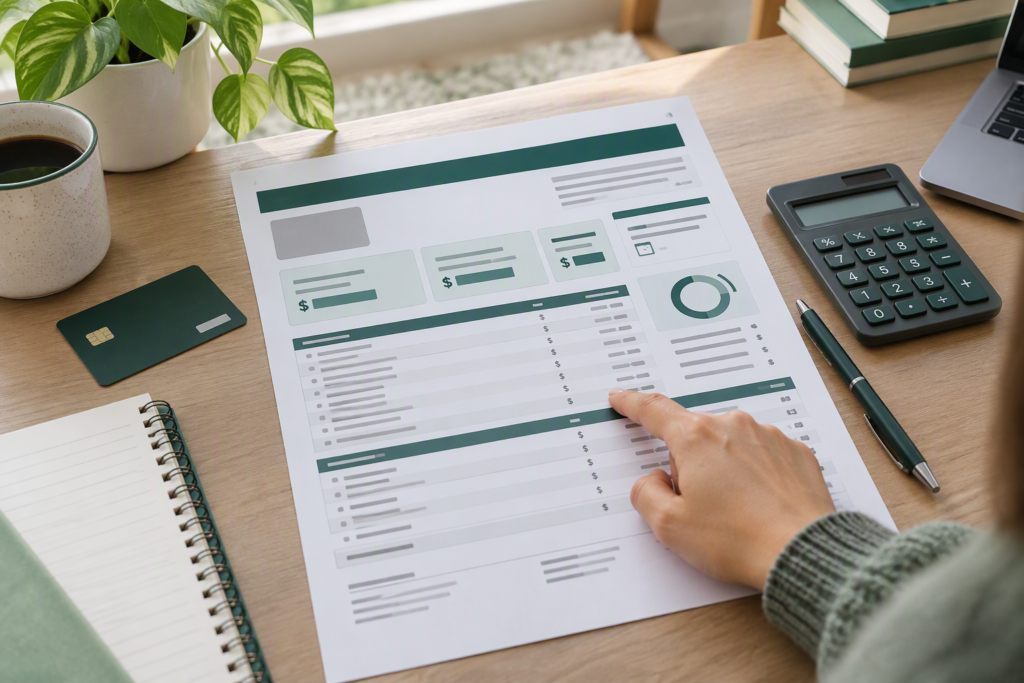
A credit card statement is a periodic summary of your account activity for a billing cycle. It shows important information such as your statement balance, minimum payment, payment due date, purchases, payments, credits, interest charges, fees, and available credit.
What You'll Learn to Check
- ✓ Find your statement balance, minimum payment, and payment due date.
- ✓ Review purchases, payments, credits, and other account activity.
- ✓ Identify interest charges, fees, and the APRs that may apply to different types of balances.
- ✓ Spot information that may need a closer review before your next payment is due.
WHY THIS MATTERS
The 5 Numbers to Check First on Your Credit Card Statement
A credit card statement contains a lot of information, but you do not need to read every line in the same order. Start with a few key numbers that tell you what is due, when it is due, and what the account cost during the billing cycle.
The first number to locate is your payment due date. This tells you when the required payment must be received according to your statement.
Next, find the statement balance and minimum payment. These numbers answer two different questions: how much was shown as the balance at the end of the billing cycle, and how much you are required to pay at minimum for that statement.
Then review your credit limit or available credit, along with any interest charges and fees. Together, these numbers give you a fast snapshot of what happened on the account before you move on to individual transactions.
PARENT GUIDE How Credit Cards Work: A Beginner’s Guide →KEY IDEA
Start with the numbers that affect your next payment, then work through the transactions, interest, fees, and other details that explain how your statement reached that balance.
STEP-BY-STEP METHOD
How to Read Your Credit Card Statement Step by Step
You do not need to understand every line at once. Start with the information that affects your next payment, then work through the account activity, transactions, interest, fees, and available credit.
STEP 1
Find the Billing Cycle and Account Summary
Start by identifying the statement period or billing cycle. This tells you which period of account activity is being summarized on the statement.
Then locate the account summary. This section usually brings together your previous balance, payments, credits, purchases, fees, interest charges, and the new balance for the cycle.
PRACTICAL TIP
Do not assume the balance shown in your banking app today will match the balance on the statement. The statement reflects a completed billing cycle, while your current account information may include newer activity.
STEP 2
Check the Due Date, Statement Balance, and Minimum Payment
These are three of the most important numbers on the statement, but they do not mean the same thing.
- Payment due date: when the required payment is due.
- Statement balance: the balance shown when the billing cycle closed.
- Minimum payment: the minimum amount required for that statement.
The minimum payment is not the same as paying the entire statement balance. Paying only the minimum can leave a remaining balance that may continue to generate interest, depending on the account and type of balance.
GO DEEPER Statement Balance vs. Current Balance vs. Minimum Payment →STEP 3
Follow How the Statement Reached Its New Balance
Your account summary helps explain how the balance changed during the billing cycle. A simplified statement might look like this:
This is an educational example. Your statement may organize these categories differently and may include additional types of account activity.
STEP 4
Review Every Transaction, Payment, and Credit
Move from the summary to the detailed activity. Review each purchase and compare it with what you remember spending during the billing cycle.
- Purchase or transaction date
- Merchant or transaction description
- Purchase amount
- Payments you made
- Refunds or account credits
- Transactions you do not recognize
PRACTICAL TIP
A merchant may appear under a business name that is different from the name you recognize. Investigate an unfamiliar charge before assuming it is unauthorized.
STEP 5
Review Interest Charges, APRs, and Fees
Look for any interest charged during the billing cycle and review the APR information shown on the statement. Different types of balances, such as purchases or cash advances, may have different APRs.
Also check for fees. Depending on the account and activity, these could include an annual fee, late fee, cash-advance fee, balance-transfer fee, foreign transaction fee, or another charge allowed under the card agreement.
IMPORTANT
Seeing an APR on your statement does not necessarily mean that the same rate applies to every type of transaction or balance on the account.
STEP 6
Check Your Credit Limit and Available Credit
Finally, review the credit limit and available credit shown on the statement. Your credit limit is the maximum amount of credit the issuer has made available on the account, while available credit reflects how much of that line remains available at that point.
- Does the credit limit look correct?
- Does the available credit make sense based on the balance?
- Are there pending or recent transactions not reflected here?
- Have you reviewed all interest charges and fees?
How much of your revolving credit you are using can also matter for credit scoring, although scoring models and lenders may evaluate credit information differently.
Learn how credit utilization works →REAL-LIFE EXAMPLE
What a Credit Card Statement Can Look Like
A simplified example can make the different sections of a credit card statement easier to understand and show how the numbers connect.
EXAMPLE STATEMENT
A Statement With a $742 Balance
Assume a credit card statement closes with a new balance of $742. During the billing cycle, the account started with a $620 previous balance, received a $400 payment, added $510 in new purchases, and incurred $12 in interest charges.
| Statement Item | Amount |
|---|---|
| Previous balance | $620 |
| Payments and credits | −$400 |
| New purchases | +$510 |
| Fees | $0 |
| Interest charged | +$12 |
| New statement balance | $742 |
| Minimum payment due | $35 |
WHAT THIS SHOWS
The Statement Balance Comes From Activity During the Billing Cycle
The account did not simply move from $620 to $742 because of new purchases. The $400 payment reduced the balance, while $510 in purchases and $12 in interest increased it.
The $35 minimum payment is a separate figure. It represents the minimum amount required for this example statement, not the total statement balance.
SIMPLE MATH
THE TAKEAWAY
Do not look only at the final balance. Reading the account summary helps you understand what increased or reduced the balance during the billing cycle.
This example is for educational purposes only. Actual statement formats, minimum-payment calculations, billing dates, interest charges, fees, and account terms vary by issuer and card agreement.
KNOW WHAT TO LOOK FOR
What Changes Depending on Your Credit Card Activity?
The basic statement-reading process stays the same, but some sections deserve more attention depending on how you used the card during the billing cycle.
CARRYING A BALANCE
If You Did Not Pay the Previous Statement in Full
Pay closer attention to interest charges, APR information, and the balance subject to interest. Depending on your card terms and whether a grace period applies, carrying a balance may increase the cost of new or existing purchases.
HIGH CARD USAGE
If Your Balance Is Close to the Credit Limit
Review the credit limit and available credit carefully. A higher reported balance can also affect credit utilization, which is one factor that may influence credit scores depending on the scoring model and lender.
UNFAMILIAR CHARGE
If You See a Transaction You Do Not Recognize
Review the merchant name, transaction date, amount, and any related receipts or account history. Some merchants appear under a different business name, but a charge you still cannot identify should not be ignored.
FEES OR CASH ADVANCES
If the Statement Includes Fees or Different Transaction Types
Look for separate fee lines and APR categories. Cash advances, balance transfers, purchases, and other transaction types can have different pricing and may not receive the same grace-period treatment.
NOT SURE WHAT DESERVES ATTENTION?
Start with the due date, statement balance, minimum payment, transactions, interest, and fees. Then spend more time on any section that looks unusual or changed from the previous cycle.
FREE VERESTLY TOOL
Review Your Credit Card Balance More Clearly
The Credit Card Balance Review helps you organize the key numbers from your card account so you can better understand your balance, payment requirements, available credit, and the information that deserves a closer look.
- ✓ Review your balance and payment information in one place.
- ✓ Organize important statement details before making your next payment.
- ✓ Identify balances, charges, or account details that may deserve additional review.
Free · Beginner-friendly · Built for clearer account reviews
STATEMENT REVIEW
Example cycle
Illustrative example only
WANT TO CHECK CREDIT USAGE?
The Credit Utilization Calculator can help you compare your balances with your credit limits and understand how much of your available revolving credit you are using.
TAKE ACTION
Your Credit Card Statement Review Plan
You do not need to memorize every section of your statement. Use the same review sequence each month so important payment information, charges, interest, and fees are less likely to be missed.
START HERE
2–3 minutes
Check the Payment Information First
Before reviewing individual purchases, confirm the numbers that affect your next payment.
- Find the payment due date.
- Confirm the statement balance.
- Locate the minimum payment due.
- Check whether any past-due amount is shown.
REVIEW ACTIVITY
5–10 minutes
Review Transactions, Payments, and Credits
Work through the activity section and make sure the purchases, payments, refunds, and credits generally match what you expect from the billing cycle.
- Review each purchase and transaction amount.
- Confirm payments were credited correctly.
- Look for expected refunds or statement credits.
- Investigate charges you do not recognize.
BEFORE YOU FINISH
Check the cost
Review Interest, Fees, and Available Credit
Finish by checking whether the account generated interest or fees and whether your available credit makes sense based on the statement balance and recent account activity.
- Check the interest charged for the billing cycle.
- Review the APR categories shown on the statement.
- Look for annual, late, transaction, or other fees.
- Confirm the credit limit and available credit.
VERESTLY 6-STEP STATEMENT CHECK
Can You Explain How Your Statement Reached Its Final Balance?
Check the due date, balance, payments and credits, transactions, fees and interest, then confirm what you plan to pay. This is a Verestly educational review framework, not an official issuer or regulatory checklist.
COMMON MISTAKES
Mistakes That Make Credit Card Statements Harder to Understand
Most statement-reading mistakes come from focusing on one number and ignoring the rest of the account activity. A consistent review process makes the statement much easier to interpret.
MISTAKE
Looking Only at the Minimum Payment
The minimum payment tells you the minimum amount required for the statement, but it does not show the full amount owed for that billing cycle.
BETTER APPROACH
Review the statement balance, minimum payment, and due date together so you understand what each number represents.
MISTAKE
Confusing the Statement Balance With the Current Balance
Your current balance can include transactions that happened after the statement closed, while the statement balance reflects the completed billing cycle shown on the statement.
BETTER APPROACH
Check the statement closing period before comparing the statement with the balance currently shown in your account.
MISTAKE
Skipping the Transaction List
Looking only at the final balance can hide duplicate charges, unexpected purchases, missing credits, or transactions you do not recognize.
BETTER APPROACH
Review purchases, payments, refunds, and credits line by line before you consider the statement complete.
MISTAKE
Ignoring Interest Charges and Fees
Interest and fees can increase the amount you owe even when your purchase activity has not changed very much.
BETTER APPROACH
Review interest charges, APR categories, and fees every billing cycle so you can see what is increasing the cost of the account.
MISTAKE
Assuming Every Statement Will Look Exactly the Same
Credit card issuers may organize statements differently. Labels, page layout, transaction sections, and account details can vary even though the same core information is generally being communicated.
BETTER APPROACH
Focus on the function of each section rather than memorizing where one particular issuer places it on the page.
REMEMBER
A credit card statement is most useful when you read it as a connected record: payment information, account activity, interest, fees, and available credit all help explain what happened during the billing cycle.
FREQUENTLY ASKED QUESTIONS
Common Questions About Credit Card Statements
These answers cover some of the most common questions beginners have when reviewing balances, payments, transactions, interest, and other information on a credit card statement.
What is the most important information on a credit card statement? +
Start with the payment due date, statement balance, and minimum payment. Then review your transactions, payments, credits, interest charges, fees, credit limit, and available credit.
Reading these sections together gives you a clearer picture of what happened during the billing cycle and what requires attention before the payment due date.
Is the statement balance the amount I currently owe? +
The statement balance reflects the balance shown when that billing cycle closed. Your current balance may be different because it can include payments, purchases, refunds, or other activity that happened after the statement was generated.
Compare statement balance, current balance, and minimum payment →Do I only need to pay the minimum payment? +
The minimum payment is generally the smallest amount required for that statement. It is not the same as paying the full statement balance.
Paying only the minimum can leave a remaining balance and may result in additional interest over time, depending on the account, transaction type, and card terms.
Why is my current balance different from my statement balance? +
Your statement balance is tied to a completed billing cycle. Your current balance can continue changing after that cycle closes as new purchases, payments, refunds, credits, fees, or other transactions post to the account.
That difference is normal and does not automatically indicate an error.
Why does my credit card statement show more than one APR? +
Different types of balances can be subject to different APRs. For example, purchases, cash advances, or balance transfers may have separate rates depending on the terms of the card.
Review the interest-charge and APR sections of the statement together rather than assuming one APR applies to every type of account activity.
What should I do if I see a charge I do not recognize? +
First review the merchant name, transaction date, amount, receipts, and recent account activity. Some transactions appear under a business or payment-processing name that differs from the name you remember.
If you still believe the charge is incorrect or unauthorized, contact the card issuer promptly. Billing-error and unauthorized-transaction protections can involve specific procedures and deadlines, so do not simply wait for the next statement.
KEEP LEARNING
Continue With the Next Most Useful Credit Guides
These topics build on the concepts used when reading a credit card statement and help explain balances, interest, and credit usage in more detail.
Statement Balance vs. Current Balance vs. Minimum Payment
Understand what each balance figure means and why the numbers shown in your account may be different.
Read the guide → UNDERSTAND BORROWING COSTSHow Credit Card Interest Works
Learn how interest can be charged and why carrying a balance can make credit-card purchases more expensive.
Read the guide → UNDERSTAND CREDIT USAGEWhat Is Credit Utilization and How Does It Work?
Learn how balances compare with credit limits and why utilization may influence credit scores.
Read the guide →WANT THE BIGGER PICTURE?
Return to the beginner guide for a broader explanation of purchases, billing cycles, payments, balances, credit limits, interest, and responsible credit card use.
SOURCES & METHODOLOGY
How We Verified This Guide
Verestly reviewed primary Consumer Financial Protection Bureau resources and federal credit-card disclosure rules to verify how periodic statements present balances, payments, due dates, transactions, APRs, interest charges, fees, available credit, and billing-error information.
LAST REVIEWED
October 2026
This guide is periodically reviewed for accuracy, clarity, source quality, and changes to U.S. credit-card disclosure and consumer-protection rules.

ABOUT THE AUTHOR
Edvaldo Ribeiro
Edvaldo Ribeiro creates beginner-focused personal-finance education for Verestly, with an emphasis on practical systems, clear explanations, and actionable financial tools.
View author profile →THE VERESTLY NEWSLETTER
Build a Better Money System, One Step at a Time
Get practical guides, financial tools, and beginner-friendly
resources designed to help you make clearer money decisions.
✓ Practical financial education
✓ New calculators and tools
✓ Actionable money systems
No spam. Just practical money guidance. Unsubscribe anytime.


RELATED ANSWERS
Keep Exploring
Continue with three closely related guides selected to deepen your understanding.
We use essential cookies to keep Verestly running and optional cookies for analytics and advertising. You can accept, reject, or customize your preferences at any time. Learn more in our Cookie Policy.