SAVING · DEBT PAYOFF GUIDE
How to Pay Off Credit Card Debt Without Draining Your Cash
Learn how to reduce credit card debt while keeping enough cash available for essential expenses, required payments, and unexpected costs that could otherwise send you back into debt.
QUICK ANSWER
The Short Answer
To pay off credit card debt without draining your cash, cover essential expenses first, keep required minimum payments current, protect enough accessible cash for realistic near-term needs, and direct the remaining surplus toward the card. The goal is to reduce debt without leaving yourself so short on cash that the next unexpected expense forces you to borrow again.
What You'll Do
- ✓ Calculate how much cash is truly available after essential expenses and required payments.
- ✓ Protect a reasonable cash floor based on your income stability and near-term risks.
- ✓ Use genuine monthly surplus and cash above that floor to accelerate the balance.
- ✓ Recheck the payment amount whenever your income, bills, or upcoming expenses change.
WHY THIS MATTERS
Why Paying Off Debt Too Aggressively Can Leave You Financially Exposed
Paying down a credit card faster can reduce the balance and may reduce future interest costs, but using too much of your available cash can create a new problem if an essential or unexpected expense appears.
Credit card debt and cash reserves serve different purposes. Paying down debt reduces money you already owe, while accessible cash can help cover expenses that cannot wait for your next paycheck.
If you keep substantially more cash than you need while carrying a high-interest balance, the debt may continue generating unnecessary interest. But if you empty your checking or savings accounts to make one large payment, you may have to borrow again when a car repair, medical bill, or income disruption occurs.
The practical goal is to find the middle ground: protect the cash needed for essential expenses and realistic short-term risks, then use genuine surplus to accelerate the credit card balance.
PARENT GUIDE How to Pay Off Debt: A Beginner’s Guide →KEY IDEA
The strongest payment is not simply the largest one you can make today. It is the largest payment your cash flow can sustain without forcing you to borrow again.
STEP-BY-STEP METHOD
How to Pay Down Credit Card Debt Without Draining Your Cash
The goal is to reduce your credit card balance without using money that is still needed for essential expenses, required payments, or realistic near-term financial risks. Work through the steps in order before deciding how much extra cash can go toward the card.
STEP 1
Calculate Your Real Monthly Surplus
Start with monthly take-home income, then subtract the expenses that must be covered before you decide how much extra money can go toward credit card debt.
Include essential living costs, required debt payments, and any known near-term expenses. What remains is your preliminary monthly surplus.
PRACTICAL TIP
Do not treat your checking-account balance as available debt payoff money until you have accounted for bills and expenses that have not been paid yet.
STEP 2
Keep Essential Expenses and Minimum Payments Covered
Before accelerating the debt, make sure the money needed for essential expenses and required minimum payments remains available.
- Housing
- Utilities
- Groceries
- Transportation
- Insurance
- Required debt minimums
STEP 3
Set a Cash Floor Before Making Extra Payments
Decide how much accessible cash should remain available based on your income stability, essential expenses, and realistic short-term financial risks.
The cash floor used in this guide is a Verestly educational framework, not a universal savings rule. The amount you choose may differ based on your circumstances.
STEP 4
Account for Upcoming Irregular Expenses
Before using cash above your floor, check whether any known expenses are approaching. Money already needed for an upcoming obligation is not true debt payoff surplus.
- Insurance premiums
- Car maintenance
- Medical expenses
- School or childcare costs
- Annual or seasonal bills
STEP 5
Send Genuine Surplus Toward the Card
Once essential expenses, minimum payments, upcoming obligations, and your chosen cash floor are protected, the remaining money becomes a stronger candidate for an extra credit card payment.
IMPORTANT
Do not count the same dollar twice. Money needed for an upcoming expense is not also available for debt repayment.
STEP 6
Recheck the Plan Before Every Extra Payment
A sustainable extra-payment amount can change as income, bills, and other financial obligations change. Review your cash position before repeating the same payment automatically.
- Did your income change?
- Did an essential expense increase?
- Is a large irregular bill approaching?
- Would the extra payment push you below your cash floor?
REAL-LIFE EXAMPLE
What a Sustainable Credit Card Payoff Month Can Look Like
The easiest way to see how this works is to separate essential spending, required payments, near-term expenses, and the cash you choose to keep available before deciding how much extra can go toward the card.
EXAMPLE SCENARIO
Jordan Brings Home $4,400 This Month
Jordan has $3,500 in accessible savings and wants to reduce a credit card balance without leaving too little cash available for essential expenses and unexpected costs.
| Category | Amount |
|---|---|
| Take-home income | $4,400 |
| Essential and committed expenses | $3,450 |
| Required credit card minimum | $250 |
| Upcoming irregular expense | $300 |
| Monthly cash already committed | $4,000 |
| Monthly surplus | $400 |
WHAT THIS SHOWS
Jordan Has Two Potential Sources for an Extra Payment
After essential expenses, the required minimum payment, and the known irregular expense are covered, Jordan has $400 of monthly surplus.
Jordan also has $1,000 of existing savings above the chosen $2,500 cash floor. That means some or all of that $1,000 may also be available for debt reduction after checking for any other near-term obligations.
SIMPLE MATH
THE TAKEAWAY
Jordan could potentially combine the $400 monthly surplus with some or all of the $1,000 above the chosen cash floor to make an extra credit card payment without using the $2,500 Jordan wants to keep accessible.
This example is illustrative, not a recommendation or prediction. Your safe payment amount depends on your income, expenses, credit card balance, APR, upcoming obligations, and the amount of cash you decide to keep available.
ADAPT THE METHOD
What Changes If Your Situation Is Different?
The core approach stays the same: protect essential cash, keep required payments current, and use genuine surplus to reduce the balance. What changes is how much cash you may need to preserve before making extra payments.
IRREGULAR INCOME
If Your Income Changes From Month to Month
A larger cash buffer may be more important when income is unpredictable. Base extra debt payments on a conservative income estimate rather than assuming every month will be strong.
LOW CASH RESERVES
If You Have Very Little Cash Available
Avoid sending every remaining dollar to the card if doing so would leave you unable to handle a basic unexpected expense. You may need to preserve or rebuild some accessible cash while continuing to keep required payments current.
UPCOMING EXPENSES
If You Know a Large Expense Is Coming Soon
Money already needed for an insurance bill, medical expense, essential repair, or another known obligation is not true payoff surplus. Set it aside before deciding how much extra can go to the card.
STRONGER CASH POSITION
If You Already Have Cash Above Your Chosen Floor
Cash that is not needed for essential expenses, upcoming obligations, or your chosen reserve may be a stronger candidate for an additional credit card payment. You can also combine that amount with recurring monthly surplus.
NOT SURE HOW MUCH CASH TO KEEP?
Start with your actual near-term risks, income stability, and upcoming essential expenses. There is no single cash-floor amount that fits every household, so your payoff amount should adapt as those conditions change.
VERESTLY PLANNING FRAMEWORK
Organize Your Debt Payoff Without Losing Sight of Your Cash
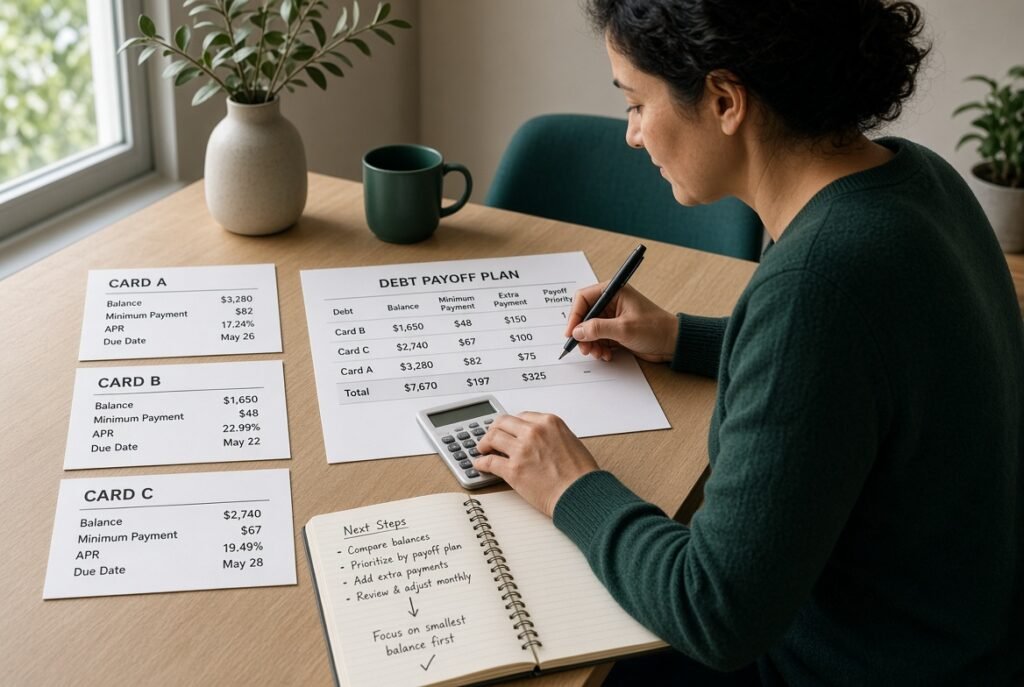
A structured debt-payoff plan can help you separate required payments, extra debt payments, essential expenses, and the cash you want to keep available before deciding how aggressively to reduce your credit card balance.
- ✓ See required debt payments alongside your available monthly cash.
- ✓ Separate protected cash from money that may be available for extra payments.
- ✓ Adjust your payoff amount when income, bills, or upcoming expenses change.
Beginner-friendly · Built for sustainable debt planning
MONTHLY PLAN
Example month
Illustrative example only
WANT TO UNDERSTAND THE COST OF THE BALANCE?
Review how credit card interest works before deciding how much additional cash to direct toward the balance.
TAKE ACTION
Your Credit Card Debt Payoff Action Plan
You do not need to commit all of your available cash at once. Start by identifying what must stay protected, calculate your real surplus, and make an extra payment only with money your current cash flow can reasonably support.
TODAY
15–20 minutes
Find Your Real Available Cash
Write down your take-home income, essential expenses, required debt payments, and any known near-term costs before deciding how much money is actually available for an extra card payment.
- Confirm your current take-home income.
- List essential monthly expenses.
- Include all required debt minimums.
- Account for known irregular expenses coming soon.
THIS WEEK
Protect your cash
Set Your Cash Floor and Choose the Extra Payment
Decide how much accessible cash you want to keep available based on your income stability, essential needs, and realistic short-term risks. Then identify the amount above that floor that may be available for debt reduction.
- Choose a reasonable cash floor for your situation.
- Separate protected cash from genuine surplus.
- Check for upcoming expenses before sending extra money.
- Keep the required minimum payment current.
BEFORE THE NEXT EXTRA PAYMENT
Review and adjust
Check Whether the Payment Still Fits Your Cash Flow
Review your income, bills, upcoming expenses, and available cash again before repeating the same extra payment. A sustainable payoff amount can change from one month to the next.
- Confirm that your income has not fallen.
- Check whether essential expenses have increased.
- Look for new irregular or unexpected costs.
- Make sure the payment will not push you below your cash floor.
QUICK CHECK
A Sustainable Extra Payment Should Answer One Simple Question
After making the payment, can you still cover essential expenses, required minimums, and realistic near-term costs without immediately needing to borrow again?
COMMON MISTAKES
Mistakes That Can Make Credit Card Payoff Harder to Sustain
Most payoff plans become difficult for a few predictable reasons. Avoiding these mistakes can help you reduce debt without creating a new cash-flow problem.
MISTAKE
Emptying Your Savings to Make One Large Payment
A large payment can reduce the balance quickly, but using nearly all of your accessible cash may leave you exposed if an essential or unexpected expense appears soon afterward.
BETTER APPROACH
Protect a reasonable cash floor first, then consider using money above that amount for an extra payment.
MISTAKE
Treating Every Dollar in Checking as Available Cash
Your account balance may include money that is already needed for rent, utilities, groceries, insurance, or other bills that have not been paid yet.
BETTER APPROACH
Subtract essential expenses, required payments, and known upcoming costs before deciding how much is true surplus.
MISTAKE
Forgetting Known Irregular Expenses
Insurance premiums, car repairs, medical costs, school expenses, and other irregular bills can make available cash look larger than it really is.
BETTER APPROACH
Set aside money for known upcoming expenses before calculating the amount available for an extra card payment.
MISTAKE
Paying Only the Minimum While Holding Unnecessary Extra Cash
Keeping more cash than your situation reasonably requires while making only minimum payments can allow the balance to remain higher for longer and may increase total interest costs.
BETTER APPROACH
Once essential cash needs are protected, consider whether some of the remaining surplus can be used to reduce the balance faster.
MISTAKE
Repeating the Same Extra Payment Without Rechecking Your Cash Flow
A payment amount that worked last month may no longer fit if your income falls, an essential expense increases, or a large bill is approaching.
BETTER APPROACH
Recalculate your available surplus before each extra payment and adjust the amount when your financial situation changes.
REMEMBER
The goal is not to make the largest possible payment once. It is to make repeatable extra payments without weakening the cash position you need to avoid new debt.
FREQUENTLY ASKED QUESTIONS
Common Questions About Paying Off Credit Card Debt Without Draining Your Cash
These questions cover the situations that most often come up when you are trying to reduce credit card debt while keeping enough cash available for everyday financial needs.
Should I use all my savings to pay off credit card debt? +
Not automatically. Before using savings, consider what expenses are coming soon, how stable your income is, and how much accessible cash you want to keep available for realistic financial shocks.
Cash above that chosen floor may be a stronger candidate for an extra payment, but the appropriate amount depends on your own circumstances.
Should I build savings or pay off credit card debt first? +
The choice does not always need to be all-or-nothing. You may decide to protect some accessible cash while also paying more than the required minimum toward the card.
The right balance can vary based on income stability, essential expenses, upcoming obligations, and the cost of the debt.
Is paying only the minimum enough? +
Paying at least the required minimum on time can help keep the account from becoming delinquent, but minimum-only repayment can make a balance take much longer to eliminate and may increase total interest costs.
Once essential cash needs are protected, paying more than the minimum can help reduce the balance faster.
Understand statement balances, current balances, and minimum payments →Does carrying a credit card balance help build credit? +
No. You do not need to carry a balance and pay interest simply to build credit.
Credit outcomes can depend on several factors and may vary by scoring model or lender, but intentionally carrying interest-bearing debt is not required for responsible credit use.
Learn how responsible credit card use works →What if I have several credit cards? +
Keep required payments current across your accounts when possible before deciding where additional payoff money should go.
Choosing which balance to target first is a separate debt payoff strategy decision. The important point for this guide is that the extra payment should still come from genuine surplus rather than cash needed for essential expenses.
What if I cannot afford the minimum payment? +
If essential expenses and the required minimum payment cannot both be covered, the problem is no longer simply deciding how large an extra payment should be.
Contact the card issuer as early as possible to explain the situation and ask whether hardship or payment-assistance options are available. You may also consider speaking with a reputable nonprofit credit counselor.
KEEP LEARNING
Continue With the Next Most Useful Guides
These guides deepen the credit and payment concepts that can help you make more informed debt payoff decisions.
How Credit Card Interest Works
See how interest can accumulate and why reducing a balance sooner may lower future borrowing costs.
Read the guide → UNDERSTAND YOUR PAYMENTStatement Balance vs. Current Balance vs. Minimum Payment
Understand the key payment amounts shown on a credit card account before building your payoff plan.
Read the guide → BUILD THE FOUNDATIONHow Credit Cards Work: A Beginner’s Guide
Review the core mechanics of credit cards, balances, payments, interest, and responsible account use.
Read the guide →WANT THE COMPLETE DEBT PAYOFF SYSTEM?
A broader Debt Payoff guide will connect repayment priorities, payoff methods, multiple balances, and ongoing debt management into one complete beginner framework.
SOURCES & METHODOLOGY
How We Verified This Guide
Verestly prioritizes primary government sources and consumer regulators when reviewing credit card debt, interest, emergency savings, payment difficulties, and consumer assistance. Examples in this guide are illustrative and are not predictions of individual financial outcomes.
LAST REVIEWED
September 2026
This guide was reviewed for credit-card accuracy, consumer-finance guidance, source quality, clarity, and responsible treatment of debt and cash-flow decisions.

ABOUT THE AUTHOR
Edvaldo Ribeiro
Edvaldo Ribeiro creates beginner-focused personal-finance education for Verestly, with an emphasis on practical systems, clear explanations, responsible credit use, and actionable financial tools.
View author profile →VERESTLY NEWSLETTER
Get Practical Money Guides and Tools
Join Verestly for beginner-friendly financial education, practical debt and saving systems, new tools, and resources you can actually use.
Free resources · Beginner-friendly · Unsubscribe anytime
RELATED GUIDES
Continue Learning
Explore three additional guides selected to help you understand credit card costs, protect your cash, and make more informed debt payoff decisions.