BUDGETING · IRREGULAR INCOME GUIDE
How to Budget With Irregular Income
Learn how to build a flexible budget around changing income, choose a realistic planning baseline, manage cash-flow timing, and adjust your spending plan when income is higher or lower than expected.

QUICK ANSWER
The Short Answer
To budget with irregular income, start with the money you can actually use, calculate your required expenses, choose a realistic planning baseline, map when income and bills occur, and assign each payment according to your current priorities. Review and adjust the plan whenever your income changes instead of expecting every month to follow the same budget.
What You'll Learn
- ✓ How to separate usable income from money that is only expected or still pending.
- ✓ How to identify the expenses your budget needs to fund before flexible spending.
- ✓ How to choose a realistic planning baseline without relying on your best month.
- ✓ How to manage the timing of uneven income and monthly bills.
- ✓ How to adjust your spending plan during lower- and higher-income months.
UNDERSTAND THE CHALLENGE
Why Irregular Income Changes the Way You Budget
When your income changes from month to month, the budget has to account for more than how much you earn. You also need to consider when money arrives, which expenses must be covered first, and how much flexibility your plan needs when income is lower than expected.
Your income amount can change
Freelance work, commissions, tips, seasonal jobs, variable hours, and gig work can produce very different income from one month to the next. A budget built around one fixed paycheck number may therefore be unreliable.
Payment timing matters
You can earn enough over the course of a month and still run short if bills are due before your income arrives. Irregular-income budgeting therefore needs to track timing as well as monthly totals.
Expected income is not available income
An unpaid invoice, projected commission, future shift, or anticipated client payment can help you forecast, but it cannot fund today's expenses until the money is actually available.
Strong and weak months need different responses
Lower-income months may require tighter prioritization, while stronger months create additional allocation choices. A flexible budget plans for both instead of treating every month as if it should look the same.
The goal is not to predict your income perfectly. It is to create a spending plan that can keep adjusting as new income and expenses become known.
SEE THE SYSTEM
How an Irregular-Income Budget Fits Together
Budgeting with variable income works best as a repeating system. Instead of trying to predict one perfect monthly income number, you identify what money is available, fund what matters most, account for timing, and adjust the plan as new income arrives.
Available Income
Start with money you can actually use, not income that is still expected or pending.
Required Spending
Identify the expenses that need to be funded before more flexible categories.
Planning Baseline
Choose a realistic reference amount that does not rely on every month being a high-income month.
Cash-Flow Timing
Compare when money arrives with when bills and other important expenses are due.
Allocation and Adjustment
Assign each payment deliberately, then update the plan when income or expenses change.
The sequence matters more than perfect prediction
With predictable pay, a budget can often begin with a stable monthly income figure. With irregular income, that number may change before the month is over. The budget therefore needs to work from current information while leaving room for later adjustments.
This also means that monthly totals are only part of the picture. A household can earn enough over the full month and still face a short-term gap if several bills are due before the next payment arrives.
The goal is not to force every month into the same shape. It is to use a consistent decision process even when the income itself is inconsistent.
CORE PRINCIPLE
An irregular-income budget should create consistency in your decisions, not require consistency in your income.
BUILD YOUR SYSTEM
How to Build an Irregular-Income Budget
A flexible budget starts by separating money you can actually use from money you only expect to receive. From there, identify what must be funded, choose a realistic planning baseline, and account for when income and expenses occur.
STEP 1
Start With Income You Can Actually Use
With irregular income, the first number in your budget should not automatically be everything you expect to earn. Start with money that is actually available to support your household plan.
For an employee with variable hours, that may simply mean take-home pay. For a freelancer, contractor, or business owner, some incoming money may need to cover business costs, taxes, or other obligations before the remainder becomes available for personal spending.
- Record income that has already been received.
- Track expected income separately for forecasting.
- Do not assign unpaid invoices to current spending.
- Separate amounts committed to other obligations before budgeting them.
KEY IDEA
Expected income can help you plan ahead, but received income is what can fund today's budget.
STEP 2
Calculate Your Required Spending
Next, identify the expenses your household needs to fund before more flexible spending. This gives you a practical reference for how much income is already committed.
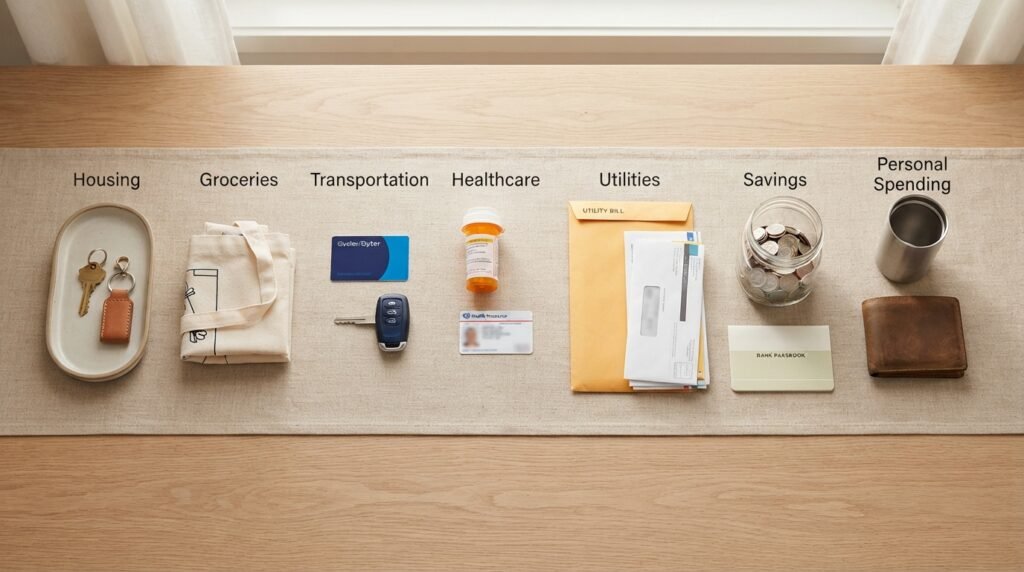
Required spending will vary by household, but it may include housing, utilities, basic groceries, transportation, insurance, healthcare, caregiving, and minimum required debt payments.
- Separate required expenses from flexible wants.
- Include essential variable costs such as groceries and transportation.
- Account for minimum required payments and recurring obligations.
- Review categories when your actual costs change.
IMPORTANT
Required spending is not your entire budget. It is the amount you need to understand before deciding how much flexibility the current month can support.
STEP 3
Choose a Realistic Planning Baseline
Your planning baseline is a conservative income amount you can use when deciding what level of recurring spending feels sustainable. It is a planning reference, not a prediction of exactly what you will earn.
Review several months of usable income rather than building your budget around your strongest month. Depending on your income pattern, a lower-but-typical month or another conservative reference may be more useful.
AVOID THE EXTREMES
Your highest month may overstate what you can regularly support, while one unusually bad month may be too restrictive to use as a permanent baseline.
STEP 4
Map When Income and Expenses Happen
Monthly totals do not tell the whole story when payment dates change. You can earn enough over the course of a month and still run short if important bills are due before your next payment.
Add timing to your budget by mapping expected payment dates, bill due dates, recurring expenses, and other known spending. A week-by-week view can be especially useful when income arrives at several different points during the month.
CASH-FLOW CHECK
Do you have enough money available when each important expense needs to be paid?
STEP 5
Assign Each Payment by Priority
When income arrives, decide what that money needs to accomplish before treating the entire payment as available for flexible spending.
The exact order will depend on your household, but an educational allocation sequence can help you decide where available money needs to go next.
- Fund urgent obligations and essential bills.
- Cover necessary variable spending.
- Prepare for known upcoming obligations.
- Allocate money toward appropriate savings or reserves.
- Fund other goals and intentional flexible spending.
FLEXIBLE BY DESIGN
The priority order is a decision tool, not a universal ranking. Housing, healthcare, caregiving, transportation, and other constraints can change what needs attention first.
STEP 6
Adjust the Budget as Reality Changes
An irregular-income budget is not something you set once and leave untouched for the rest of the month. New payments, delayed income, and changing expenses may require you to update your allocations.
Useful review points include when a significant payment arrives, when expected income is delayed, when a major expense changes, or before making a large discretionary purchase.
- Check how much usable money is available now.
- Identify what must be funded before the next likely payment.
- Review what has changed since the previous plan.
- Reassign money when current priorities change.
REMEMBER
Adjusting the budget is part of the system. It does not mean the budget failed.
VERESTLY FRAMEWORK
The Verestly Irregular Income Allocation Framework
Irregular-income budgeting becomes easier when you use the same decision process each time money arrives. The goal is not to make your income predictable. It is to make the way you allocate it more consistent.
Know What Money You Can Use
Start with income that is actually available for your household budget. Keep unpaid invoices, projected commissions, and other expected income separate until the money arrives.
Fund What Needs to Be Covered
Identify required expenses and upcoming obligations before deciding how much of the current income can support more flexible spending or other priorities.
Match Income to Expense Timing
Look beyond monthly totals and check when bills are due compared with when your next payments are likely to arrive. Timing can create a cash-flow gap even when the month balances overall.
Give Each Dollar a Job
Allocate available income deliberately across current obligations, necessary variable spending, upcoming costs, financial priorities, and intentional flexible spending.
Update the Plan When Reality Changes
Revisit your allocations when income arrives late, a payment is larger or smaller than expected, or an expense changes. The budget is designed to adapt as new information becomes available.
THE CORE IDEA
AVAILABLE → REQUIRED → TIME → ASSIGN → ADJUST is a Verestly educational framework, not a universal financial rule. Its purpose is to create consistency in your decisions even when your income itself is inconsistent.
PRACTICAL EXAMPLE
How an Irregular-Income Budget Works in Practice
A variable-income budget becomes easier to understand when you can see the numbers change from month to month. This illustrative example shows how a planning baseline can be used without assuming that every month will produce the same income.
ILLUSTRATIVE SCENARIO
Start With the Recent Income Pattern
Assume a household receives income from freelance or project-based work and the amount available for the household budget changes each month. During the last six months, usable income ranged from $3,100 to $5,200.
Instead of building recurring spending around the strongest month, the budget uses a $3,400 planning baseline. Actual income is then used to adjust the plan as money arrives.
| January | $3,100 |
|---|---|
| February | $4,450 |
| March | $3,600 |
| April | $5,200 |
| May | $3,300 |
| June | $4,100 |
| Six-month average | $3,958 |
| Planning baseline | $3,400 |
| Required monthly spending | $3,100 |
APPLYING THE FRAMEWORK
What Happens in a $4,600 Income Month?
AVAILABLE
Confirm Usable Income
First confirm that the full $4,600 is actually available for the household budget after accounting for any amounts that should not be treated as personal spending money.
REQUIRED
Cover Required Spending
Next, account for the $3,100 of required monthly spending, such as housing, utilities, groceries, transportation, insurance, and other obligations.
TIME
Check Upcoming Due Dates
Review which bills must be paid before the next expected income deposit and keep enough cash available to cover those obligations.
ASSIGN
Allocate the Stronger Month
This month produced $1,200 more than the $3,400 planning baseline. That additional income can be deliberately assigned to future needs, savings goals, debt, irregular expenses, or flexible spending.
ADJUST
Update the Plan as Income Changes
If the next payment arrives late or another expense changes, revise the allocation rather than assuming the original plan must stay fixed.
THE TAKEAWAY
A Strong Month Creates Options, Not a New Spending Baseline
A $4,600 month does not automatically justify increasing recurring expenses. The planning baseline remains $3,400, while the additional $1,200 can be assigned deliberately according to current needs and priorities. If a later month comes in below the baseline, the budget can be adjusted again.
This example is illustrative only. It does not represent a recommended income level, spending amount, or allocation. A realistic planning baseline depends on your actual income pattern, required expenses, payment timing, financial priorities, and household circumstances.
ADJUST TO THE MONTH YOU HAVE
What Should You Do When Your Income Changes?
An irregular-income budget should respond differently depending on what actually happens. Compare this month's usable income with your planning baseline, then choose the path that best matches your current cash-flow situation.
IF INCOME IS BELOW YOUR BASELINE
Protect the expenses that matter most
When usable income comes in lower than planned, start with required obligations and necessary variable expenses. Review which flexible categories can be reduced, postponed, or reassigned before committing money elsewhere.
IF INCOME IS NEAR YOUR BASELINE
Follow the normal spending plan
When income lands reasonably close to your planning baseline, use the regular allocation you built around required expenses, current priorities, and realistic flexible spending.
IF INCOME IS ABOVE YOUR BASELINE
Decide what the extra income should accomplish
A stronger month creates more allocation choices, but it does not automatically create room for permanently higher spending. Decide how the additional income fits into future expenses, financial priorities, and intentional wants.
IF THE MONTH BALANCES BUT CASH STILL RUNS SHORT
Fix the timing problem, not just the monthly total
If total income appears sufficient but money is unavailable when bills are due, review payment dates, bill timing, and what must remain available before the next expected payment.
NEED A PLANNING NUMBER?
Turn Your Income History Into a Practical Starting Point
Use the Verestly irregular-income budgeting tool to organize recent income, compare it with required spending, and create a clearer baseline for planning lower and higher-income months.
Practical · Beginner-friendly · Built for variable income
FREE VERESTLY TOOL
Build a More Realistic Irregular-Income Budget
Use the Verestly Irregular Income Budget Calculator to turn changing income into a clearer planning baseline. Compare recent income with required spending and see how much room different months may leave for other priorities.
- ✓ Organize recent income without assuming every month will be the same.
- ✓ Compare your planning baseline with required monthly spending.
- ✓ See how lower-, baseline-, and higher-income months may change your available margin.
Free · Beginner-friendly · Designed for variable income
START WITH YOUR INCOME
What has your usable income looked like recently?
PREFER TO PLAN MANUALLY?
Use a budgeting worksheet to record actual income, required expenses, due dates, and the adjustments you make as new payments arrive.
PUT IT INTO ACTION
Your 30-Day Irregular-Income Budgeting Plan
You do not need to make your income predictable before your budget can become useful. Use the next 30 days to understand your income pattern, build a realistic baseline, improve cash-flow timing, and create a review process you can repeat whenever money changes.
TODAY
20–30 minGather Your Recent Income Numbers
Start by looking at several recent months of usable income. Record what actually became available for household spending, not only invoices, projected commissions, or other income you expected to receive.
- Record at least several recent months of usable income.
- Note the highest, lowest, and more typical months.
- Keep pending or expected income in a separate forecast.
WEEK 1
Build your baselineCalculate Required Spending and Choose a Planning Baseline
Identify the expenses that need to be funded before flexible spending, then compare those costs with your recent income pattern. Choose a conservative planning baseline that does not depend on every month being a strong month.
- List required household expenses.
- Separate required costs from more flexible categories.
- Choose a baseline that reflects your actual income pattern.
WEEK 2
Map the timingPut Income Dates and Bill Dates on the Same Calendar
Add timing to the budget. Mark when income is expected to arrive, when recurring bills are due, and when larger variable expenses usually happen. This helps reveal gaps that monthly totals alone can hide.
- Mark expected payment dates.
- Add major bill due dates and recurring expenses.
- Check whether enough cash is available before each due date.
WEEK 3
Build allocation rulesDecide What Each New Payment Should Fund First
Create a simple allocation order so that new income does not become unplanned spending. Start with obligations that need funding before the next likely payment, then move to other priorities as available income allows.
- Fund urgent obligations and necessary spending first.
- Prepare for known upcoming expenses.
- Decide how stronger months will support future priorities.
WEEK 4
Build the review habitCreate Your Repeatable Budget Review
Review what happened during the month and decide when your budget should be revisited going forward. With irregular income, significant payments and changing expenses can be better review triggers than waiting for a fixed date.
- Compare actual income with your planning baseline.
- Review which expenses changed or arrived at different times.
- Update your baseline or allocation rules only when the pattern supports it.
KEEP IT FLEXIBLE
The Goal Is a Repeatable Process, Not a Perfect Income Month
A useful irregular-income budget gives you a way to make decisions as money arrives. Keep the parts that improve visibility, timing, and allocation, then adjust the system as your income pattern changes.
AVOID THESE PITFALLS
Common Irregular-Income Budgeting Mistakes
Variable income creates a few predictable budgeting traps. Most come from using assumptions that work better with a fixed paycheck than with income that changes in amount or timing.
Building the Budget Around Your Best Month
A strong income month can make higher recurring spending look affordable even when several other months would not comfortably support it.
Use a realistic planning baseline informed by several months of actual income rather than your strongest result.
Treating Expected Income as Available Money
Unpaid invoices, projected commissions, future shifts, and anticipated client payments can all arrive later than expected or change in amount.
Keep expected income in your forecast, but assign spending from money that is actually available.
Looking Only at Monthly Totals
Total monthly income can exceed total monthly expenses while you still run short because important bills are due before the next payment arrives.
Track payment dates and bill due dates so the budget reflects cash-flow timing as well as monthly totals.
Using One Rigid Percentage Every Month
A fixed percentage split can become unrealistic when income falls but housing, transportation, healthcare, or other required expenses remain relatively stable.
Use percentage-based methods as flexible frameworks, not requirements that every month must reproduce.
Letting a Strong Month Become a New Normal
Increasing subscriptions, payments, or other recurring commitments after one high-income month can make future lower months harder to manage.
Treat above-baseline income as additional resources to allocate, not automatic permission to raise fixed costs.
Treating Every Adjustment as a Failed Budget
Irregular income changes. Payment timing changes. Expenses change. A plan that never needs updating may simply not reflect what is happening.
Review what changed, reassign available money, and treat adjustment as part of the budgeting process.
FREQUENTLY ASKED QUESTIONS
Questions About Budgeting With Irregular Income
These answers address the most common decisions that come up when your income changes from month to month.
Should I budget using my lowest-income month?
It can be a useful conservative reference, but it is not automatically the right baseline for everyone. Review several months of usable income and choose a planning level that reflects your real pattern without depending on your strongest month.
Should I use my average monthly income?
An average can help you understand your income history, but it may hide low months. Compare the average with your actual income range and required spending before using it to support recurring commitments.
What if my income cannot cover essential expenses in a low month?
Prioritize the most consequential obligations and reduce or postpone flexible spending where possible. But a budget cannot make insufficient income cover expenses that exceed available resources. A persistent gap may require broader changes or additional assistance beyond budgeting.
Does zero-based budgeting work with irregular income?
It can. The idea of giving available money a specific job can fit variable income well because each new payment can be assigned according to current priorities. The detailed zero-based method should still be adapted to changing income rather than treated as a rigid monthly template.
Can I use the 50/30/20 rule with irregular income?
Yes, as a reference framework rather than a requirement. Fixed expenses and lower-income months may make the standard percentages unrealistic, so the split may need to change as your actual income changes.
See how the 50/30/20 framework works →How often should I review an irregular-income budget?
Review it whenever meaningful information changes. That may include when a significant payment arrives, expected income is delayed, a major expense changes, or before a large discretionary purchase. For highly variable income, these event-based reviews can be more useful than waiting for the next calendar month.
CONTINUE YOUR JOURNEY
Where to Go Next
Once your irregular-income budget is working, the next step depends on what still creates the most friction. Choose the path that matches your current need and continue with the most relevant budgeting or supporting guide.
IMPROVE TIMING
Budget Individual Payments More Precisely
Choose this path if income arrives several times during the month and your main challenge is deciding which bills and expenses each payment needs to cover.
CHOOSE A METHOD
Adapt a Budgeting Framework to Variable Income
Use this path if you understand your baseline and cash flow but want a clearer method for assigning available money without forcing every month into the same structure.
BUILD FLEXIBILITY
Prepare for Future Expenses and Lower-Income Months
Choose this path if your budget is becoming more stable and you want to reduce how much each month's bills depend on that month's exact income.
REVIEW AND ADJUST
Keep Improving the Budget as Your Income Changes
Use this path if the system is working but you want a more deliberate process for reviewing actual results, correcting overspending, and adjusting future allocations.
ONE STEP AT A TIME
Keep the Budget Flexible as Your Income Pattern Evolves
Your planning baseline, bill timing, and allocation priorities may change as your income becomes more or less predictable. Revisit the system when the underlying pattern changes rather than forcing an old budget to keep working.
SOURCES & METHODOLOGY
How We Built This Guide
This guide combines practical budgeting principles with primary U.S. government research and consumer-education resources. Sources were used to verify income-variability data, cash-flow budgeting concepts, spending-plan mechanics, and tax considerations that can affect people with variable or self-employment income.
LAST REVIEWED
September 2026
We periodically review this guide for accuracy, clarity, source quality, and changes to budgeting, income, or tax information that may affect readers with irregular income.

ABOUT THE AUTHOR
Edvaldo Ribeiro
Edvaldo Ribeiro creates beginner-focused personal-finance education for Verestly, with an emphasis on clear explanations, practical budgeting systems, and actionable tools that help readers make more informed money decisions.
View author profile →VERESTLY NEWSLETTER
Build a More Flexible Money System
Get practical budgeting guides, financial tools, and beginner-friendly resources designed to help you make clearer decisions when income, expenses, and priorities change.
- Practical budgeting education
- New calculators and tools
- Flexible money systems
Free resources · Beginner-friendly · Unsubscribe anytime
KEEP LEARNING
Related Budgeting Guides
Continue with practical guides that help you plan around payment timing, organize monthly spending, and make your budget easier to adjust.