BUDGETING · BEGINNER GUIDE
How to Create a Beginner Budget You’ll Actually Use
Learn how to build a realistic budget around the income and expenses you actually have, decide where your money needs to go, and adjust the plan as your month changes.

QUICK ANSWER
The Short Answer
To create a beginner budget, start with the income you can actually use, review what you currently spend, list your required and flexible expenses, and assign realistic amounts to each category. Then make sure the plan fits within your available income, track what happens during the month, and adjust the budget as needed.
What You'll Learn
- ✓ How to calculate the income you can realistically budget.
- ✓ How to use your actual spending to build realistic categories.
- ✓ How to separate necessary commitments from more adjustable spending.
- ✓ How to build a monthly plan that fits the money available.
- ✓ How to review and adjust your budget instead of expecting it to be perfect.
BEFORE YOU BUILD YOUR BUDGET
Gather the Numbers You’ll Actually Use
A realistic budget starts with evidence, not guesses. Before deciding what you want to spend, collect enough information to see how money is coming in, where it is going, and which expenses are already committed.
Check your recent income
Gather recent pay statements, direct deposits, or other reliable income records. Focus on the money that is actually available after taxes and payroll deductions.
Review recent transactions
Look through checking-account activity, card transactions, receipts, or other spending records so your first budget reflects what you actually spend—not what you think you spend.
List your recurring bills
Write down regular obligations such as housing, utilities, insurance, loan payments, subscriptions, childcare, and any other bills that repeatedly claim part of your income.
Note due dates and less-frequent costs
Record when major bills are due and flag expenses that do not happen every month, such as annual fees, vehicle costs, school expenses, gifts, or seasonal purchases.
You are not trying to fix your spending yet. At this stage, the goal is simply to create an accurate starting point. A few recent months of records can be especially useful when your spending changes from one month to the next.
STEP 1 · START WITH INCOME
Calculate the Income You Can Actually Budget
Your budget starts with the money that is realistically available to use—not your salary before taxes or income you hope might arrive. Begin with take-home income and add only other income you can reasonably expect during the month.
Start With Take-Home Pay
Use the amount that reaches you after taxes and payroll deductions.
Add Reliable Income
Include other income you can reasonably expect during the month.
Leave Out Uncertain Money
Do not build required spending around income that may not arrive.
Total the Month
Add the income you expect to have available for the budget period.
Use That as Your Limit
This total is the amount your planned allocations need to fit within.
Use spendable income, not headline income
Suppose your gross pay is $4,600 per month, but taxes, insurance, retirement contributions, and other payroll deductions reduce the amount deposited into your account to $3,700. For budgeting purposes, the $3,700 is the more useful starting number because that is the money available to allocate.
If you receive two regular paychecks of $1,850 each during the month, your available monthly income would be $3,700 before adding any other reliable income. Treat this as a planning baseline, not a target for how much you should spend.
If your income changes substantially from month to month because of hourly schedules, commissions, seasonal work, tips, self-employment, or similar factors, the same principle applies, but the amount you plan around may need a more conservative method.
CORE PRINCIPLE
Build your budget around income you can realistically use—not money you have not received or cannot reliably count on.
STEP 2 · TRACK REAL SPENDING
Find Out What You Actually Spend
A beginner budget works better when it starts with real spending patterns instead of ideal estimates. Review recent transactions, group similar expenses, and use what you find to build categories that reflect your actual financial life.
START WITH EVIDENCE
Review Your Recent Transactions
Look through recent checking-account activity, credit-card transactions used for everyday spending, receipts, and any other records that show where your money has been going.
A few recent weeks can give you a useful starting point, while several months can help reveal expenses that change over time. You are not judging the spending yet. You are trying to make the first version of your budget accurate enough to use.
KEY IDEA
Build your first budget from what you actually spend before deciding what you want to change.
CREATE USEFUL CATEGORIES
Group Similar Spending Together
You do not need dozens of categories to create a useful budget. Start by grouping spending into broad areas that help you see where your money is going and where future decisions may be needed.
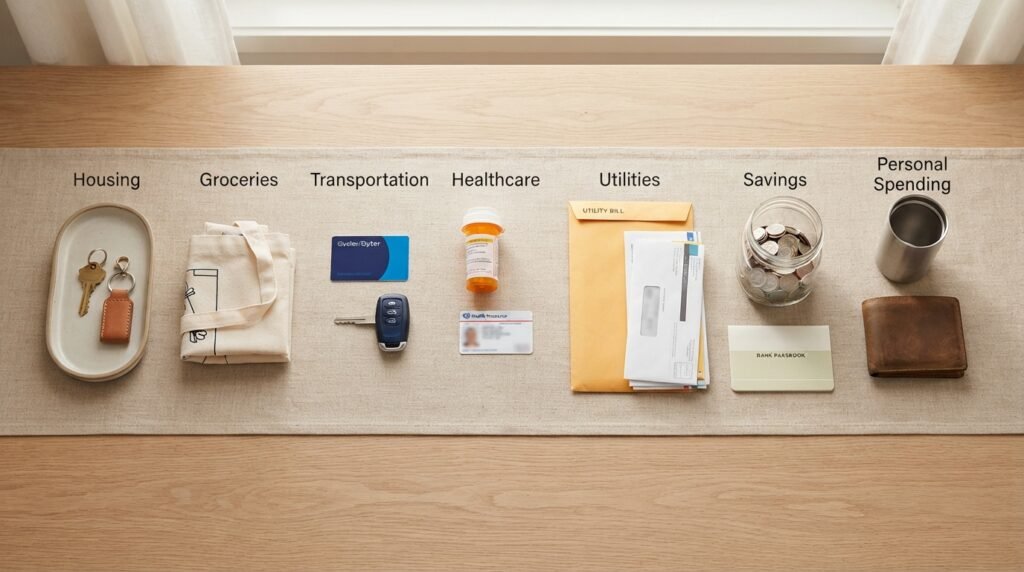
- Housing and utilities.
- Groceries and household expenses.
- Transportation and insurance.
- Healthcare and personal care.
- Debt payments and other recurring obligations.
- Dining, entertainment, subscriptions, and other flexible spending.
Another household may need categories for childcare, caregiving, education, pets, family support, or other recurring responsibilities. A category is useful when it helps you make a budgeting decision.
CHECK YOUR ASSUMPTIONS
Compare What You Think You Spend With What You Actually Spend
Beginners often build a budget around numbers that feel reasonable. The problem is that a reasonable guess may still be far from what your household typically spends.
For example, you might expect groceries to cost $350 per month, but recent transactions show that your actual spending has been closer to $465. Starting with $465 gives you a more realistic baseline. You can decide later whether that amount should change.
LOOK FOR PATTERNS
Identify Spending That Repeats
As you review transactions, mark expenses that happen repeatedly. These might include utilities, subscriptions, insurance premiums, childcare, loan payments, transportation costs, memberships, or other regular commitments.
Repeated spending deserves special attention because it can consume a significant part of your monthly income even when each individual charge looks small.
REMEMBER
A recurring expense does not automatically mean it is unnecessary. The goal is to make sure it is visible in the plan.
LOOK BEYOND THIS MONTH
Flag Expenses That Do Not Happen Every Month
Some costs are easy to miss because they appear only a few times a year. Vehicle registration, annual memberships, school expenses, gifts, seasonal purchases, routine maintenance, and certain insurance payments can all distort a budget if they are ignored.
For your first budget, simply identify the important nonmonthly expenses you already know about. Later, you can decide how to plan ahead for them more systematically.
BUILD THE BASELINE
Turn Your Spending History Into a Starting Budget
Once your transactions are grouped, you have a practical baseline for the next step. Some categories may already look reasonable. Others may need adjustment once you compare them with your income and priorities.
Do not force every category lower just because you are creating a budget. A realistic first version is more useful than an idealized plan you cannot maintain.
NEXT STEP
With your actual spending visible, you can now separate regular commitments, variable necessities, flexible spending, and periodic expenses.
STEP 3 · ORGANIZE YOUR EXPENSES
Separate the Expenses Your Budget Needs to Handle
Once you know what you actually spend, sort those expenses by how they behave. The goal is not to label every purchase perfectly. It is to understand which costs are committed, which can change, and which may appear only occasionally.
Regular Commitments
These expenses tend to stay similar from month to month, such as rent or mortgage payments, certain insurance premiums, loan payments, internet service, or recurring subscriptions.
Necessary Costs That Change
Groceries, utilities, fuel, healthcare, and household supplies can vary from month to month while still being necessary parts of your budget.
More Adjustable Spending
Dining out, entertainment, hobbies, optional shopping, and some subscriptions may give you more room to adjust when the budget needs to change.
Costs That Do Not Happen Monthly
Annual fees, vehicle registration, school costs, gifts, seasonal purchases, and routine maintenance can still belong in your plan even when they are not due every month.
Money You Intentionally Set Aside
When your situation allows, your budget can also assign money toward savings, future expenses, or additional debt payments. These allocations should fit around the realities of your income and required costs.
THE CORE IDEA
Variable does not mean unnecessary. A cost can change from month to month and still be essential. The useful distinction is how predictable and adjustable an expense is when you need to make trade-offs.
STEP 4 · BUILD THE PLAN
Build Your First Monthly Budget
Now bring the pieces together. Start with the income available to you, assign realistic amounts to the expenses and priorities you identified, then check whether the total fits within that income.
EXAMPLE BUDGET
Meet Taylor
Taylor has $3,700 in monthly take-home income and wants to create a first budget based on current expenses rather than an idealized spending plan.
The goal is not to force every category into a predetermined percentage. It is to make sure the planned allocations fit the money actually available.
| Housing | $1,250 |
|---|---|
| Utilities | $220 |
| Groceries | $450 |
| Transportation | $350 |
| Insurance | $180 |
| Minimum debt payments | $250 |
| Healthcare and personal care | $130 |
| Household expenses | $120 |
| Dining and entertainment | $220 |
| Subscriptions | $60 |
| Future expenses / savings | $300 |
| Miscellaneous buffer | $120 |
| Total planned | $3,650 |
| Available monthly income | $3,700 |
| Amount remaining | $50 |
BUILD IT STEP BY STEP
How Taylor Builds the Plan
INCOME
Start With Available Income
Taylor begins with $3,700 of take-home income—the amount actually available to allocate during the month.
OBLIGATIONS
Add Required Costs First
Housing, utilities, insurance, transportation, minimum debt payments, and other recurring obligations enter the plan before more flexible categories.
DAILY LIFE
Plan Realistic Variable Spending
Taylor uses recent spending to set amounts for groceries, household costs, healthcare, and other expenses that change from month to month.
FLEXIBILITY
Add Adjustable Spending
Dining, entertainment, subscriptions, and a small buffer are included at amounts Taylor believes are realistic enough to follow.
CHECK
Compare the Plan With Income
Planned allocations total $3,650, leaving $50 unassigned. Taylor can keep that margin or deliberately give it another job before the month begins.
THE TAKEAWAY
Your Budget Only Needs to Fit Your Reality
The example above is not a recommended allocation. Another household could need much more for housing, childcare, healthcare, transportation, or other essentials. What matters is that your own planned spending and priorities fit within the income realistically available to you.
This example is illustrative, not a recommended budget split. Your actual categories and amounts should reflect your income, obligations, household needs, priorities, and local costs.
WHEN THE NUMBERS DON'T FIT
What If Your Budget Doesn't Balance?
If your planned expenses are higher than the income available, do not immediately assume you need more discipline. First find out what is creating the gap, then adjust the parts of the plan that can realistically change.
CHECK THE INPUTS
Make sure the numbers are accurate
Review your income and expense totals for duplicated charges, missing income, incorrect estimates, or expenses entered in the wrong amount. Keep accurate costs accurate rather than lowering them simply to make the budget appear balanced.
FIND WHAT CAN CHANGE
Separate required costs from more adjustable spending
Housing, basic utilities, groceries, transportation, healthcare, childcare, and other obligations may leave limited short-term room. Dining, entertainment, optional purchases, and some recurring services may be easier to adjust.
CHECK THE TIMING
See whether the problem is cash-flow timing
A monthly budget can balance overall while still leaving you short before the next paycheck. Compare income dates with bill due dates to see whether too many obligations are concentrated in one part of the month.
RECOGNIZE A STRUCTURAL GAP
Necessary expenses still exceed available income
If reasonable adjustments still leave essential expenses above the income available, the problem is larger than category choices. The budget is showing an income-and-cost gap that spending organization alone cannot eliminate.
IMPORTANT DISTINCTION
A Budget Can Reveal a Shortfall—It Cannot Create Income
If required expenses remain higher than the money available after realistic adjustments, do not force the numbers to fit on paper. Keep essential costs visible and treat the remaining gap as a separate financial problem that may require changes to major costs, income, payment arrangements, or available assistance.
The goal is a workable plan—not a mathematically balanced budget built on unrealistic assumptions.
STEP 5 · USE THE BUDGET
Use Your Budget During the Month
Creating the plan is only the beginning. A useful budget stays active throughout the month so you can compare what you planned with what is actually happening and make adjustments before a small difference becomes a larger problem.
- ✓ Check important categories regularly instead of waiting until the end of the month.
- ✓ Compare upcoming bills with the timing of your next paycheck or income deposit.
- ✓ Reallocate money when one category changes instead of treating every difference as a budgeting failure.
A short weekly check-in can be easier than trying to reconstruct the entire month later.
BUDGET STATUS
What changed since your last check?
WATCH THE TIMING
A budget can balance for the month and still leave you short during a particular week. Keep income dates and major bill due dates visible so you can distinguish a cash-flow timing problem from a true monthly shortfall.
STEP 6 · REVIEW AND IMPROVE
Review Your First Month and Adjust the Next One
Your first budget is a starting version, not a permanent rulebook. At the end of the month, compare what you planned with what actually happened, identify the differences, and use what you learned to make the next budget more realistic.
COMPARE
Planned vs. actualCompare the Plan With What Really Happened
Look at each major category and compare the amount you planned with what you actually spent. The goal is not to judge the result—it is to find where your assumptions were accurate and where they were not.
- Review total income received during the month.
- Compare planned and actual spending by category.
- Note any expenses that were missing from the original plan.
DIAGNOSE
Find the reasonUnderstand Why the Numbers Were Different
A category can miss its target for very different reasons. The original estimate may have been too low, the month may have been unusual, or the spending may have changed in a way you want to address.
- Separate one-time events from recurring patterns.
- Identify categories that were consistently underestimated.
- Check whether bill timing created unexpected pressure.
ADJUST
Improve the baselineChange the Budget Where Reality Says You Should
If a category was repeatedly too low, consider raising the planned amount rather than forcing the same unrealistic target into the next month. If another category was consistently lower, you may be able to reduce it.
- Raise categories that were realistically underfunded.
- Reduce categories that were consistently overestimated.
- Reallocate money instead of changing every category at once.
CHECK THE SYSTEM
Keep what worksReview the Budgeting Process Itself
Sometimes the problem is not the category amount. It may be the way the budget is organized, how often you check it, or whether the plan matches the timing of your income.
- Decide whether weekly check-ins were frequent enough.
- Simplify categories that were too detailed to maintain.
- Keep bill due dates visible if timing caused problems.
REBUILD
Next monthCreate Version Two of Your Budget
Use the information from your first month to create the next budget. Keep the categories and habits that worked, update the ones that did not, and account for any known expenses coming up.
- Update category amounts using actual spending data.
- Add known nonmonthly expenses for the upcoming period.
- Carry forward only the rules that made the budget easier to use.
KEEP THIS MINDSET
An Over-Budget Category Is Information
A difference between planned and actual spending does not automatically mean the budget failed. It tells you whether the spending changed, the estimate was unrealistic, or the plan needs a better structure. Each review gives you better information for the next month.
AVOID THESE BUDGETING PITFALLS
Common Beginner Budgeting Mistakes
Most beginner budgets do not fail because someone is “bad with money.” They fail because the plan starts with unrealistic assumptions, leaves out important expenses, or is never adjusted after real life happens.
Budgeting From Gross Income
Starting with salary before taxes, insurance, retirement contributions, or other payroll deductions can make the budget appear to have more money available than it really does.
Build the plan from take-home income or the money that is realistically available to allocate.
Guessing Instead of Checking Your Spending
A category amount can feel reasonable and still be far below what you normally spend, making the budget unrealistic before the month even begins.
Review recent transactions first, then use actual spending as the starting baseline for your categories.
Forgetting Nonmonthly Expenses
Annual fees, vehicle costs, school expenses, gifts, maintenance, and seasonal purchases can make an otherwise balanced budget feel unexpectedly tight.
Identify important periodic expenses early and make room for them in your planning.
Making Flexible Categories Too Restrictive
Cutting dining, entertainment, hobbies, or personal spending to unrealistically low amounts may make the plan look stronger while making it harder to use consistently.
Use realistic amounts and make deliberate trade-offs instead of designing the budget around perfect behavior.
Treating Every Overspend as Failure
Spending more than planned in one category can mean the estimate was wrong, the month was unusual, or another part of the budget needs adjustment.
Treat the difference as information, identify the cause, and decide whether the spending or the plan should change.
Creating the Budget and Never Reviewing It
A budget becomes less useful when it is treated as a document you create once instead of a plan you check and update as the month changes.
Use short check-ins during the month and a fuller review before building the next budget.
FREQUENTLY ASKED QUESTIONS
Beginner Budgeting Questions
These short answers cover common questions that come up when you are creating and using a budget for the first time.
Do I need a specific budgeting method to get started?
No. You can start with the basic process in this guide: identify available income, review actual spending, assign realistic amounts, check that the plan fits your income, then track and adjust it. Methods such as 50/30/20, zero-based budgeting, paycheck budgeting, and irregular-income budgeting are optional structures that may fit different needs.
Does every dollar need to be assigned?
Not necessarily. Some budgeting systems assign every dollar intentionally, while others leave a small amount unassigned as breathing room. What matters is knowing where the money is expected to go and keeping the total within the income realistically available.
What if my income changes from month to month?
Use conservative income assumptions and prioritize essential expenses first. Because irregular income requires additional planning around high- and low-income months, a dedicated irregular-income budgeting method may be more useful than a standard fixed monthly plan.
Learn how to budget with irregular income →Do I need to track every purchase?
Not necessarily. You need enough visibility to understand whether your categories and total spending are staying close to the plan. Some people prefer transaction-level tracking, while others can manage effectively with regular category check-ins.
What should I do if I overspend in one category?
Check why the overspending happened. If it was a realistic increase in a necessary expense, you may need to reallocate money from another category. If the category repeatedly runs over budget, the planned amount or the spending pattern may need a more permanent adjustment.
How often should I review my budget?
A short weekly check can help you catch changes while there is still time to adjust, and a fuller review at the end of the month can help you build a better plan for the next one. You can review more often if your income or expenses change frequently.
CONTINUE YOUR BUDGETING JOURNEY
Where to Go Next
Your first budget gives you a working baseline. From here, choose the next guide based on the part of budgeting that needs more structure—your categories, timing, income pattern, or monthly review.
ORGANIZE YOUR PLAN
Get More Specific About Your Budget Structure
Choose this path if building the first budget showed that you need clearer categories, a repeatable monthly process, or a budgeting framework with more structure.
MATCH YOUR PAY CYCLE
Budget Around Individual Paychecks
If your monthly totals work but bills become difficult to manage between paydays, organize the plan around when each paycheck arrives and what it needs to cover.
HANDLE VARIABLE INCOME
Adapt the Budget When Income Changes
If earnings vary because of hourly work, commissions, tips, self-employment, seasonal work, or other factors, use a method designed for months when available income is not predictable.
IMPROVE EACH MONTH
Turn Your First Budget Into a Repeatable System
Choose this path once you have completed a month and want to compare planned versus actual spending, correct weak estimates, and build a more realistic budget for the next month.
KEEP THE NEXT STEP SIMPLE
Choose the Method That Solves the Problem You Actually Have
You do not need to switch budgeting systems just because another method is popular. Keep your current plan if it works, and add more structure only where it helps you manage income, spending, timing, or review more effectively.
SOURCES & METHODOLOGY
How We Built This Budgeting Guide
Verestly reviewed primary government guidance and household-finance data to support the budgeting process in this guide. The sources below informed how we explain income, real-world spending, bill timing, income variability, and differences in household expenses.
LAST REVIEWED
September 2026
We periodically review this guide for accuracy, clarity, source quality, search-intent ownership, and changes that may affect beginner budgeting guidance.

ABOUT THE AUTHOR
Edvaldo Ribeiro
Edvaldo Ribeiro creates beginner-focused personal-finance education for Verestly, with an emphasis on clear explanations, practical systems, and actionable tools that help readers make more informed money decisions.
View author profile →VERESTLY NEWSLETTER
Build a Budget That Gets Better With Every Month
Get practical budgeting guides, financial tools, and beginner-friendly resources designed to help you plan, review, and adjust your money with more clarity.
- Practical budgeting education
- New calculators and tools
- Beginner-friendly money systems
Free resources · Beginner-friendly · Unsubscribe anytime
KEEP LEARNING
Related Budgeting Guides
Continue with three carefully selected guides that help you organize, adapt, or improve the budget you just created.